Well-being isn't a benefit: it's the foundation for performance
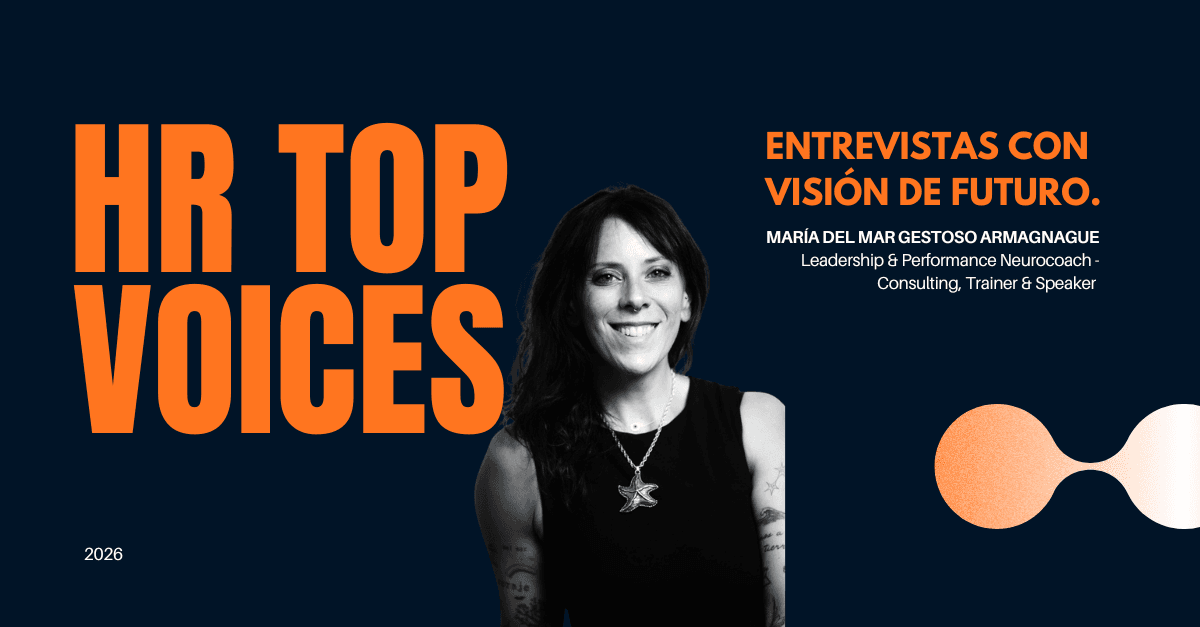
"Wellbeing Isn't a Perk: It's the Foundation for Performance"
HR TOP Voices | María del Mar Gestoso Armagnague
Wellbeing isn't a perk, it's the foundation. That's not a tagline. It's how María del Mar Gestoso Armagnague approaches People work from within, after years of building culture in startups, advising organizations, and developing the next generation of leaders.
A high-performance neurocoach, consultant, trainer, and speaker, Mar brings a refreshingly uncommon perspective to the HR world: one that blends behavioral biology, applied neuroscience, and brutal honesty about what really doesn't work in today's companies.
We spoke with her about hybrid models, feedback, AI, onboarding, and leaders who are burning out while looking perfect on the surface.
"Many companies have an office with permission to work from home"
From a behavioral neuroscience standpoint, what needs to change for hybrid to become a real culture and not just a policy?
The simplest definition of culture is "how we do what we do." From a People perspective, the goal is always to set up the environment with the best conditions so teams have what they need to achieve the company's objectives.
When people feel disconnected—under any model, since many are disconnected even with 100% in-office setups—everything becomes an uphill battle. From a neuroscience angle, I'd say it's crucial to nurture a sense of belonging through spaces deliberately designed to sustain connection with clarity, trust, and where performance doesn't hinge on being physically present.
"Wellbeing is a condition for performance, not a benefits package"
What's the most costly mistake companies make when trying to "implement wellbeing"?
I think it gets treated like a benefits package, or part of the employee value proposition, but not as a condition for performance.
In a company, we're chasing objectives, and to achieve them we need to create the best possible conditions. When people feel good, they perform better. But "feeling good" is far broader than scattered initiatives that start and stop. Wellbeing also means having psychological safety, clear rules for development, a secure communication environment, a culture of excellence, and clarity on what's expected of you to deliver strong, sustainable results.
The concept of wellbeing I subscribe to encompasses human nature across all its dimensions: cognitive and mental, physical, emotional, and spiritual. This doesn't mean the company is responsible for every one of those dimensions—they're not responsible for people's physical health, for example—but they do need to understand that the body and attention operate by specific rules. There need to be sustainable work rhythms, conversations about focus time, rest, and workload volume. We shouldn't celebrate the person running on empty; instead, we should avoid operating like a burnout machine. That's Wellbeing Culture.
"Leading a team is really about orchestrating simultaneous learning processes"
Your work blends neuroscience with organizational leadership. Is there any scientific finding that contradicts what business schools teach about people management?
I don't think it contradicts, but I do think there's insufficient understanding of how people learn—both cognitively and pedagogically.
I really believe we should have more training on how "we function as humans": learning neuroscience and behavioral sciences with thoughtful, practical application. How humans learn → how do I learn then? What works for me? What are the best strategies when I understand how my brain actually works?
Leading a team is fundamentally about orchestrating and aligning simultaneous learning processes toward shared objectives. That means understanding how behavior works, what energizes us as humans, how we learn, how our "internal machinery" functions so we can have more fluid and sustainable processes.
"The early years of a startup define the most critical pillars of culture"
You built culture from scratch at Paisanos. What's the first thing you broke that was already established but wasn't actually working?
Nothing. Personally, I believe the early years of a startup's life are really beautiful and rich because they define the most critical pillars of culture. I love the startup DNA.
Founders and CEOs are close by and set the company's personality; it's crucial to tap into that energy and build solid trust bonds. The role of a People function is to spotlight the best of all that, help define it as a north star, and ensure it's always protected.
The first step is putting into words what you're already living and working organizational learning as a path of collective habits: how we run new processes, how we communicate more structurally, who makes what decisions.
"There's no such thing as unlearning"
You say positive feedback is more effective than corrective feedback. Why?
Both are necessary. Negative feedback risks being perceived as a social threat, but it's what sets the boundary; it's crucial as a cutoff point. Positive feedback, meanwhile—praise, recognition—activates circuits more linked to motivation that allow you to repeat what went well.
Plus, it very clearly shows "what's expected of me" as a north star. Which is exactly where things often fall apart: the person knows they're doing something wrong but has no real clarity on what they should be doing instead.
And here's something I find really important and that comes up repeatedly as a mistake: there's no such thing as unlearning. Brain circuits don't erase because I decide to stop doing something. What happens is that behavior gets replaced with another one. The more I repeat something, the more those new neural connections strengthen. That's why everything new is hard at first and then becomes more fluid.
"Purpose is inherent to the person, not the role"
You tell your audience that work doesn't have to give you existential purpose. How do you sustain that position in a market where companies sell purpose as the differentiator for attracting talent?
It would be amazing if that always happened, but ideal scenarios live in fantasy land. Purpose is inherent to the person, not to the seat or the role. We're dynamic beings in an incredibly dynamic reality. Today you're in this job, tomorrow you're in another.
That said, I think you can find plenty of self-realization in your professional dimension. It's amazing how much of ourselves unfolds in how we work, how we manage pressure, how we connect with others.
"Cognitive debt is my biggest concern with AI"
How do you see AI's role in talent development?
Wonderful and worrisome at the same time. The way we learn and access information seems incredible and I'm fascinated by it; I genuinely feel like everything is within reach. Knowledge is power now more than ever.
But I'm concerned about cognitive debt and the deterioration caused by oversimplifying everything. Human beings vitally need effort, even on a biological level.
Today we talk about cognitive offloading: everything we delegate to technology—memory, creativity, synthesis, developing our ideas discursively. That creates serious problems with long-term and working memory, attention, concentration, and creativity. Pure, hard-wired brain functioning.
"The opportunity cost of burnout is invisible in the present"
As a high-performance neurocoach, what's the most repeated pattern you see in leaders who are burned out but performing flawlessly on the outside?
I think the worst part is the opportunity cost of sacrificing your own wellbeing for performance. The consequences of sustained stress aren't visible in the present, so we don't perceive them: emotional reactivity increases, quality of output drops, there's more scattered thinking, you lose cognitive flexibility.
And I circle back to the wellbeing concept: taking care of your brain, understanding the body and physical activity as fundamental to cognitive performance, caring for your nervous system and emotional health. We should think about strategies where the rule isn't "give everything for the cause," but rather regulate effort and energy in a healthy way to reach much better results than we would through sheer exhaustion.
"Rather than cutting things from onboarding, I'd focus on what really matters"
If you had to redesign onboarding from the lens of learning neuroscience, what three things would you prioritize?
Rather than cutting things, I'd focus on three fundamentals:
-
Building trust in the relationship with the leader and the team. It's the foundation for everything that follows.
-
Understanding where the real value of the position lies. Not all tasks carry equal weight, and it's important the person knows what their most valuable contribution is—both from the role and from their personality. Each person truly has a unique place within the system.
-
Cultivating a growth mindset around failure and courage from day one. We need people who dare to experiment, try things, and bring new ideas. They don't have to be brilliant or solve every problem; incremental improvements that gradually transform entire processes are enough.
"I love every decision I made"
If you could send a message to the version of yourself who started in HR ten years ago, what would you tell her to stop doing?
Nothing. I love every decision I made and every space I happened to land in. I think I gained really diverse understanding of learning—across technology and neuroscience—that adds so much to what I do. Everything we do adds value—even bad decisions—if we're paying attention to our own path.
Managing a distributed team and still juggling multiple workspace providers? With Desky you get one contract, one invoice, and access to thousands of spaces across Latin America and Europe. No fixed costs, no bureaucracy. 👉 See how Desky works for companies
About María del Mar Gestoso Armagnague
Leadership & Performance Neurocoach · Consultant, Trainer & Speaker · Specialized in organizational culture, wellbeing as the foundation for performance, and neuroscience applied to leadership.
Published by the Desky team — HR TOP Voices, 2026