Federico Manó: "Purpose is What Keeps You Afloat"
Psychologist, coach and founder of Mentify. Federico Manó recounts the day he almost shut down the company, the story of an intern who ended up mentoring a director, and which part of the gender gap falls to HR to solve.
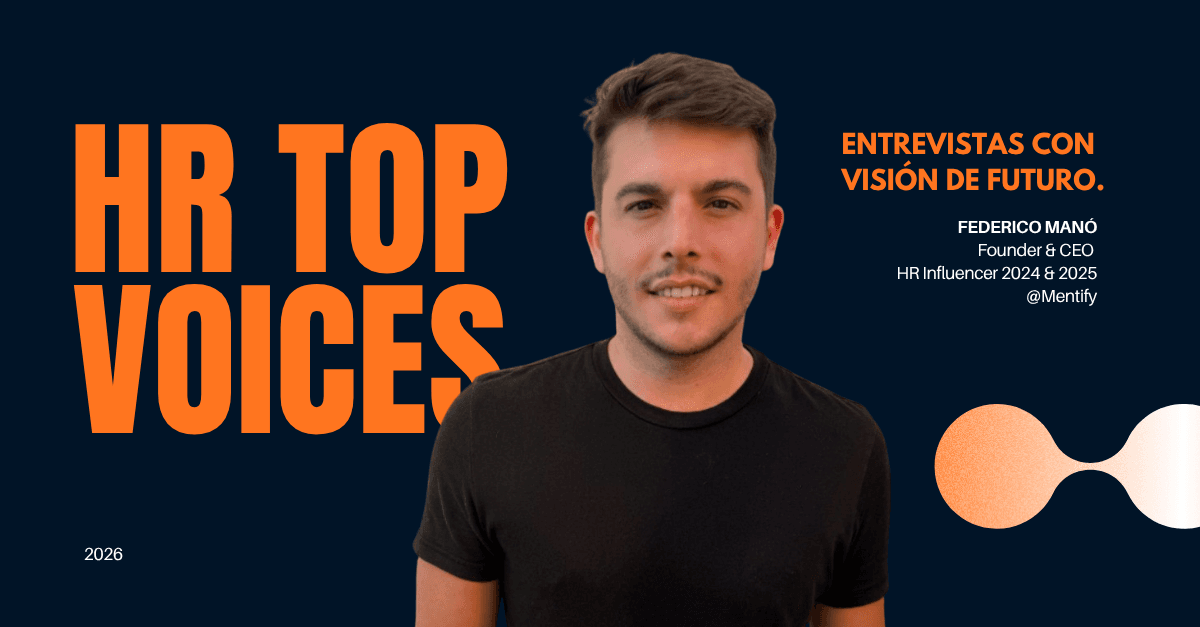
Federico Manó: "Purpose is not a nice phrase for the web, it's the life raft that keeps you afloat"
HR TOP VOICES
HR Top Voices is Desky's interview series with Workplace, People Operations and HR leaders who are rethinking how teams are managed and developed. In this edition, we spoke with Federico Manó, founder of Mentify, about peer-to-peer learning, the gender gap in decision-making positions, and what it means to sustain a human development startup in Latin America.
An intern mentoring a director. A startup that almost shut down and kept going out of conviction. And an uncomfortable question: what part of workplace inequality is HR's responsibility.
Federico Manó is a psychologist and coach specializing in neuroscience. In 2020, he founded Mentify with an idea that sounds simple and isn't: that an organization's most valuable knowledge is already inside it, distributed among its people, and that the work is connecting it.
Today Mentify combines an internal mentoring platform for companies, custom in-company mentoring programs, and open mentoring for its community. It works with a network of more than 50 mentors in Mexico, Colombia, Costa Rica, Peru, Uruguay and Argentina, and more than 5,000 people have gone through its programs.
What follows is a conversation about development, power, difficult decisions, and what technology should never replace.
The gap HR needs to bridge
87% of your community are women, but most management positions are still held by men. What part of that gap is HR responsible for closing?
Federico doesn't beat around the bush. For him, the first step is to stop asking women to adapt to a system that wasn't designed for them and start dismantling the barriers within the organization.
"The gap is not a problem with women's capacity, it's a problem of privilege and structural inequality."
Federico Manó – Founder | Mentify
That, he says, means HR must take on a political role within the company: guarantee parity in decision-making positions, eliminate the wage gap, combat motherhood bias, and create active sponsorship programs. The goal is not for female talent to occupy seats, but to exercise real power at the table where decisions are made.
The day Mentify almost shut down
You mentioned there were times when you were on the verge of closing Mentify. What happened and what made you keep going?
There were moments of great uncertainty: companies freezing training budgets, months with no cash coming in. Starting a business in Latin America, he recalls, is never a linear path, and in those moments you question everything.
What made him keep going was returning to the origin. If a startup exists only to make money, the first difficult quarter is enough to close it. Mentify was sustained by something else: the passion for human development and seeing concrete impact on people, which is what gives him energy to wake up early and find a way forward for the business.
"Clear purpose is not a nice phrase for the web, it's the life raft that keeps you afloat when the context is pressing."
Federico Manó – Founder | Mentify
What was the best people management decision you made as a leader, and which one cost you the most?
The best was betting on attitude over technical knowledge. If Mentify is a company driven by learning, its team had to reflect that. They hired junior profiles with hunger to learn and taught them everything: technical development, client management, project management, and soft skills. Seeing them grow and become independent in their roles, he says, was the most rewarding.
The one that cost him the most was accepting that when a company evolves, not everyone adapts at the same pace. Parting ways with valuable people because the company's moment called for a different type of role or maturity was, without a doubt, one of the hardest things.
An intern who mentored a director
More than 5,000 people have gone through Mentify. Is there a transformation story that particularly marked you?
Yes. In a company using Mentify's platform, which works as a learning matchmaking system between collaborators, a newly hired intern ended up mentoring an old-school director. A case of reverse mentoring.
The director needed to develop skills in diversity, inclusion, and new ways of working. In ten sessions, his perspective shifted: he learned to listen differently and changed entire dynamics in his team.
"Knowledge in a company doesn't always flow from top to bottom, and the vulnerability to learn has no hierarchy."
Federico Manó – Founder | Mentify
What peer-to-peer mentoring has that a course doesn't
What does peer-to-peer mentoring have that a traditional course or certification doesn't achieve?
Federico identifies three things. The first is context: it's not abstract theory, it's two people solving real problems within the same organizational culture. The second is internal connection: it breaks down silos between areas, reinforces sense of belonging, and generates bonds that otherwise would never happen. The third is the cultural message: validating that internal knowledge matters, democratizing learning, and giving prominence to every collaborator, both when they learn and when they teach.
An editorial note is worth adding: those connections that mentoring generates need, sooner or later, a place to meet. In distributed or hybrid teams, where mentor and mentee might be in different cities, coordinating that face-to-face meeting is often harder than it seems. Platforms like Desky solve that part by providing access to coworkings and meeting rooms in Latin America and Europe under a single contract, paying only for what you use.
Does your team need to meet up, but works from different cities? Desky gives you access to thousands of workspaces and meeting rooms in Latin America and Europe under a single contract, with no fixed costs. 👉 Discover Desky's enterprise plan
What is the question HR professionals ask most in mentorings, and what does it reveal about where the profession stands?
The most repeated question is how other companies are solving it, what best practices are working out there.
For Federico, that reveals two things. On one hand, a strong need for validation and community in a role that often feels lonely. On the other, the speed at which the area is transforming: HR no longer seeks textbook recipes, it seeks to learn from peers and see real cases to quickly adapt them to its own reality.
The costliest HR mistakes in Latin America
What is the costliest mistake you see repeating in HR departments across the region?
He sees three that keep happening. The first is designing from the desk and not from the collaborator: launching expensive training or benefits programs without understanding what people need in their daily work. The second is treating HR as a cost center rather than a business unit, measuring training hours or satisfaction instead of impact on key talent retention, time-to-productivity, or operational efficiency. The third is confusing culture with superficial benefits.
"Talent loyalty is not achieved with a ping-pong table or an after-work event, but with empathetic leaders, clarity in objectives, and transparent career paths."
Federico Manó – Founder | Mentify
If you had to explain to a CEO in a single sentence why to invest in their people department, what would you say?
"Without people there is no technology, no innovation, no added value; investing in your people is not a management cost, it's the only asset that guarantees business sustainability."
Federico Manó – Founder | Mentify
What technology should never do
On what have you changed your mind about people management in recent years?
On his view of automation. Before, it was believed that technology would replace everything. Today he is convinced that its function is to optimize operations to leave space for what makes us human.
"A bot can schedule a meeting or answer a vacation inquiry, but you should never delegate a feedback conversation or a moment of support to AI."
Federico Manó – Founder | Mentify
Empathy, context reading, and human warmth, he says, cannot be replaced.
What would you like people to say about Mentify in ten years?
That it was the company that transformed the way people grow within organizations. And that it proved that continuous learning and human connection are the true drivers of professional development in Latin America.
Frequently asked questions about mentoring and talent development
What is peer-to-peer mentoring and how is it different from a course?
It's a scheme where collaborators from the same organization learn from each other by solving real problems. Unlike a course, it occurs within the company's context and culture, breaks down silos between areas, and validates internal knowledge.
What is reverse mentoring?
It's when a person with less seniority or hierarchy mentors someone more senior, for example on topics like diversity, technology, or new ways of working. In the case Federico Manó mentions, an intern mentored a director over ten sessions and changed entire dynamics in his team.
What can HR do to reduce the gender gap in management positions?
According to Federico Manó, take an active role: guarantee parity in decision-making positions, eliminate the wage gap, combat motherhood bias, and create sponsorship programs for female talent.
How can you facilitate in-person meetings in distributed teams?
By centralizing access to workspaces and meeting rooms across multiple cities with a single provider. Desky offers this model in Latin America and Europe, with billing based on actual use and no fixed costs.
Does your team work from multiple cities and spaces to meet up have become yet another vendor to manage? Centralize access to coworkings and meeting rooms under a single contract and a single invoice, paying only for what your team uses. 👉 Explore how Desky works for companies
This article was prepared based on an interview for the HR Top Voices series, with the collaboration of the Desky team, a flexible workspace platform for remote teams in Latin America and Europe.