HR Top Voices: Iris Torres and how to build a Human Capital area from scratch
Iris Torres leads Human Capital at Energyza. She talks about how to build a people department from scratch, how to measure happiness, and why it's essential to develop talent in renewable energy.
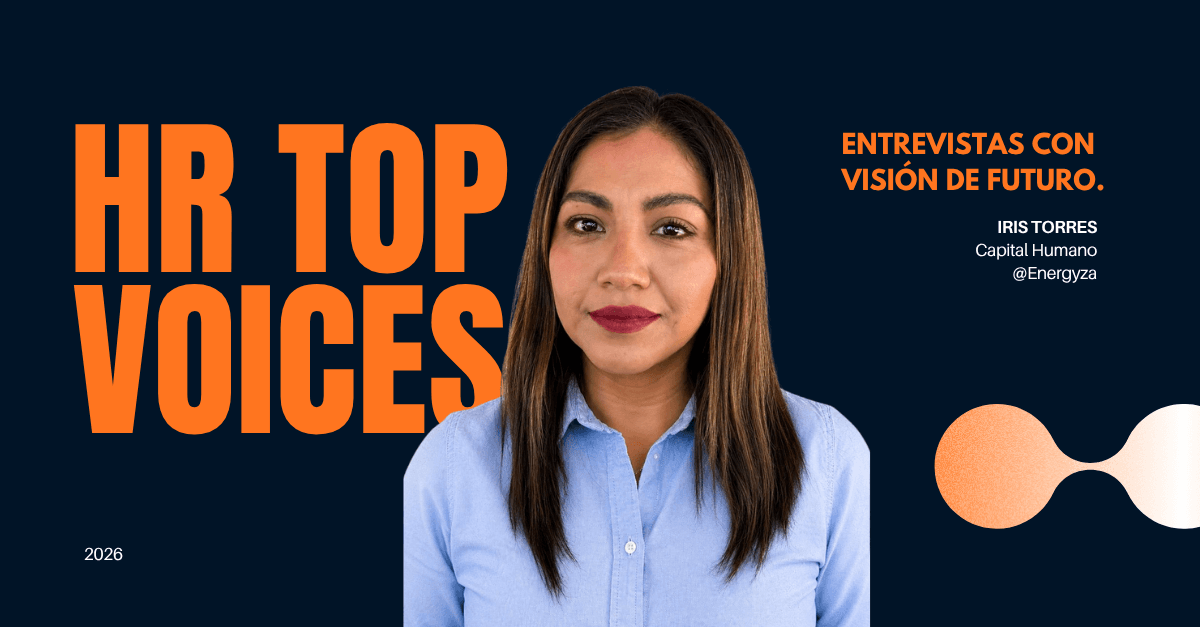
HR Top Voices: Iris Torres and Building a Human Resources Department from Scratch
HR Top Voices is the Desky segment where we talk with Human Resources leaders from Latin America about how they manage people, culture and talent.
Iris Torres has 12 years of experience in Human Capital and has worked across industries that, on the surface, seem to have nothing in common: poultry, retail and meat processing, restaurants and, today, renewable energy. She has built people departments from scratch more than once, managed teams of hundreds of people in one of the industries with the highest turnover that exist, and today leads Human Capital at Energyza.
A psychologist by training with a master's degree in Business Management, she holds a conviction that runs through the entire conversation: there is no single formula for managing people. First you have to understand how the company works and get to know its people.
We spoke with her about what to do (and what not to do) when arriving at a company where nothing is set up, how a local company competes for talent that earns in dollars, and how to measure something as difficult as happiness.
1. You wrote that working for a company that promotes renewable energy is "a source of pride and peace for my heart." In almost six years at Energyza, was there a specific moment, a person or a conversation in which you felt that your work in Human Capital changed someone's life?
Something I like about working in Human Capital is that there are many situations where you can help someone improve their day or their week. I'm not sure about their life, but at least their current situation.
I remember hiring someone who had lived through a difficult experience at their previous job. That experience had led them to move to a city they didn't like, and they felt undervalued even though they had a strong profile. I remember the call to tell them they had been selected: I could feel their emotion and relief at knowing they could return to their hometown. It made me very happy to be able to contribute to their happiness.
2. You created people departments from scratch more than once: at Corporativo GAMAS, with 1,000 employees across 16 branches and a processing plant, and at Quickshine, with 300. When you arrive at a company where nothing is set up, what is the first thing you do and what did you learn not to do?
The first thing I do is talk with as many employees as I can. I like to understand the company culture through their words, and I make sure to include in those conversations all levels and all possible lengths of service. Those conversations help me form a judgment and, from them, I start to identify the issues that are priorities in my work plan. Sometimes, starting with small changes helps generate employee trust.
The only thing I try not to do is judge immediately. I believe human beings always want to give our opinion, and we often do so without deeply understanding the issues. When we arrive at a new company, the temptation to point out and demonstrate what we know is great. We must be cautious and wait to understand why each process, issue or culture exists before calling it a problem or giving an anticipated solution.
"When we arrive at a new company, the temptation to point out and demonstrate what we know is great. We must wait to understand why each process exists before calling it a problem."
3. You worked in very different industries: poultry, retail and meat processing, restaurants and now energy. At Eladios Bar you managed 600 people across 9 restaurants, one of the industries with the highest turnover that exist. What did that world teach you that you apply today in an energy company?
It's an excellent question, because many times we think that companies, by being in different sectors, are totally different. The reality is that in Human Capital we work with the same asset, people, and that's why we find the same challenges in each company.
Now, there is something the restaurant industry left me with and that today is part of how I understand Human Capital: the importance and value of service. For me, Human Capital is the most important service department in any company. And serving doesn't simply mean attending to requests: it means listening with kindness, with respect and with genuine intention to understand.
People in Human Capital must know the needs, expectations and motivations of our employees. Only then can we design strategies that truly respond to what people need and, at the same time, what the organization requires.
"Human Capital is the most important service department in any company. And serving doesn't simply mean attending to requests: it means listening with genuine intention to understand."
4. At Energyza, on-site, remote, hybrid and employees who work on-site, at works and projects coexist. How do you decide what modality corresponds to each position?
The way we work is dictated by the very nature of the position. There are positions that, by their activities, need to be on-site at works or projects.
Currently we have four work modalities:
- A small part of the workforce is 100% on-site.
- Another part works 100% in home office.
- A percentage is hybrid between home and on-site project work.
- And a part of our employees, myself included, work in a hybrid scheme of two days in the office and three days from home.
Each modality is determined by Human Capital, with a certain flexibility that helps employees have freedom in the way they work.
5. Mérida has become a talent hub working remotely for foreign companies, often earning in dollars. How does a local company compete for that talent when it can't compete on salary alone?
I believe the main difference is that working with us means belonging to a company with national operations, in an industry of great reach. You collaborate with expert engineers in energy, and our projects help you acquire skills that few companies can offer locally.
Next is our corporate vision: we have developed a culture based on employees, and that is reflected in the flexibility and working conditions we offer, which are more attractive than those of other local companies.
6. In your description you say you want talent to feel "heard, valued and happy." Happiness is a word many in HR avoid because it sounds difficult to measure. How do you know if someone on your team is happy?
Indeed, happiness is very difficult to measure: what makes one person happy can cause the opposite in another. I have learned to measure it through other indicators.
The first is tenure: currently our voluntary turnover is very low. Another is the recommendation index: when you are satisfied at a company, you recommend it even to your family, and our employees are our main recruitment source. And finally, we constantly ask for direct feedback through an NPS survey, because numbers always help us make better decisions.
"When you are satisfied at a company, you recommend it even to your family. Our employees are our main recruitment source."
7. Today you lead a larger team with better-defined responsibilities than when you arrived at Energyza. What changed in your way of leading?
From the beginning of my time at the company I have been the area leader. When I entered, my position was a coordination because I had to lead and operate everything at the same time. Now, with a larger team and better-defined responsibilities, my vision has had to shift, and I am still in that process.
It was difficult to move away from seeing issues from an operational perspective to engaging with them from a more strategic perspective. That change has been particularly challenging for me, because I was very accustomed to solving the here and now.
8. Renewable energy needs profiles that barely exist in the market: specialists in energy storage, medium and high voltage, power purchase agreements. How do you recruit talent for an industry that is still forming? Hire or train?
Train, definitely. It has been one of the keys to our success.
We know that finding fully formed profiles is increasingly difficult, so our strategy starts with identifying potential. We look for talent with solid professional training, a learning mindset and desire to grow. From there, we provide them with training, experiences and real scenarios, accompanied by leaders who drive their development. This is how we build the skills and competencies that allow us to maintain the quality that today distinguishes each of our projects.
9. You are a psychologist and also have a master's degree in Business Management. In a recent decision, did the psychologist help you more or the executive?
Recently we lived through quite an extraordinary situation with the illness of someone very dear to the team. It has been one of the most challenging situations of my work life.
Psychology helped me understand each of the people involved: on the one hand, I had to understand the feelings and fears of the family; on the other, the concerns of the administrative team to maintain our processes.
The executive in me helped me find the way to accompany the situation without overstepping processes and regulatory compliance.
10. If someone writes to you tomorrow saying "I've just been asked to build the Human Capital department of a company that is growing fast," what would you tell them in a single message?
Never underestimate the importance of a solid foundation. Human Capital should be built on a culture that responds to the needs and objectives of the company.
The first step is to define and consolidate it: clearly establish who we are, what we value and what behaviors we need to achieve our objectives. When that foundation is clear, everything else becomes much simpler: you know what talent to attract, what to develop, what to recognize and, above all, what decisions are truly aligned with the company and which are not.
"Never underestimate the importance of a solid foundation. When the culture is clear, you know what talent to attract, what to develop and what to recognize."
3 ideas from Iris Torres to take with you
Listen before proposing. When arriving at a company, talk with all levels and all lengths of service, and understand why each process exists before calling it a problem.
Measure happiness with indirect indicators. Voluntary turnover, employee referrals as a recruitment source and NPS surveys say much more than a direct question.
When the profile doesn't exist, train it. In new industries, hiring for potential and accompanying with leaders and real projects is more sustainable than searching for the perfect candidate.
About Iris Torres
Iris Torres is a bachelor's degree holder in Psychology from the Autonomous University of Yucatán and has a master's degree in Business Management from Tecmilenio University. She has 12 years of experience in Human Capital, mainly in talent attraction, personnel administration, organizational development, compensation and labor relations.
She has worked in industries such as restaurants, professional services, agribusiness and energy, which allowed her to learn different ways of operating and understand the needs of organizations and people.
She is currently Head of Human Capital at Energyza, where, together with her team, she works on Human Capital processes, culture and internal development, accompanying the growth of the organization and its employees.
Does your company also combine on-site, remote and hybrid schemes?
With Desky, teams working from home can access professional spaces near where they live when they need them, with a single contract and paying only for what they use.
HR Top Voices is a segment of Desky. Do you know a Human Resources person who should be in this section? Write to us.