Leadership without shortcuts, from Sonora to Tokyo
Milton, HR Director Mexico and CAM at Nissin Foods, shares how he transitioned from PepsiCo and Mondelēz to a Japanese DNA culture, his 5E's Leadership framework, and why each person's career depends on themselves.
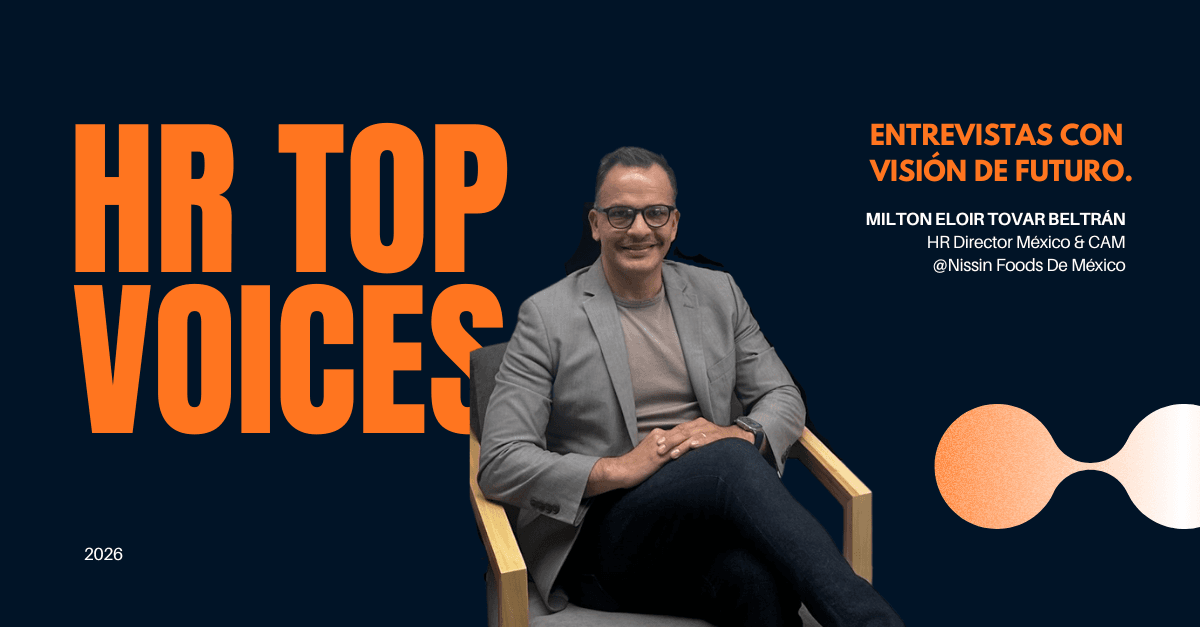
Leadership Without Shortcuts, from Sonora to Tokyo
HR Top Voices Series — In this installment of HR Top Voices, the series where we bring together the most influential voices in Human Resources in Latin America, we spoke with Milton about discipline, culture, and leadership without magic formulas.
There are executives who reach leadership positions through their résumé. And there are others who arrive through conviction — clear purpose and the sum of experiences in different environments and challenging leadership roles. Milton clearly belongs to the second group. Today he is Director of HR Mexico and CAM at Nissin Foods de México, but his story began twenty years before, in 2004, as HR Manager at LLYASA, learning from every interaction and very diverse leadership styles.
Between that starting point and his current role there was PepsiCo, there was Mondelēz International, and there were plants in Obregón, Monterrey, Mexico City, Puebla, and Tapachula, but above all, there was a question that — as he tells it — changed his career: stop asking himself "what opportunity are they going to give me?" to start asking himself "what capabilities do I need to build to be ready when the opportunity appears?".
From Mexican speed to Japanese preparation, discipline, and structure
The leap from a corporate culture like PepsiCo or Mondelēz to a company with Japanese DNA like Nissin was not automatic. Milton is honest about what he had to unlearn: the idea that speed, by itself, equals effectiveness.
"In a culture with Japanese DNA, the process also communicates," he explains. Punctuality, preparation, and attention to detail are not accessories: they are concrete manifestations of respect. Having a good idea is not enough. You have to demonstrate that you analyzed the data, that you anticipated the questions, and that you cared about how you present a recommendation.
He illustrates this with a revealing anecdote: one of his first important meetings with Japanese colleagues, where he arrived on time and with the subject mastered, but discovered that it wasn't enough. "The meeting taught me that you can be physically present and still arrive late intellectually."
From this comes one of his most repeated principles: time is respect. And a warning that applies to any leader, in any industry: "You are always being watched" — this phrase helps us remember that leadership is evaluated, above all, when we believe no one is looking.
A framework he learned and made his own: the 5 E's of Leadership
Like many leaders who went through training processes in global companies, Milton didn't keep what he learned to himself: he adopted the structure and lives it as his own. The 5 E's of Leadership model summarizes, according to him, the skills that separate leadership that thrives from one that stays in the attempt:
- Envision — create and communicate a vision that others can explain in their own words.
- Engage — capture the attention and genuine commitment of the team.
- Energize — spread energy through recognition and timely feedback.
- Enable — enable and empower so that others contribute to extraordinary results.
- Execute — ensure that each action contained within the plan is carried out with EXCELLENCE, train in problem-solving, and take responsibility for results.
"Leadership is a competency/skill that we can improve every day, not a hierarchical status," he summarizes. His aspiration, he says, is to develop people with judgment and the ability to surpass those who lead them — a phrase that is not common to hear from someone who occupies the director's chair.
Closeness to operations as an antidote to office-based HR
With more than 18 years supporting areas like Supply Chain, commercial areas, and corporate functions, Milton has an unusual perspective for a senior HR role: distrust of policies that were never tested on the floor. "HR too removed from operations can confuse activity with impact," he warns. You can celebrate the implementation of a program without asking yourself if it actually improved anything.
"Today I have the possibility of leading my teams, the HR agenda and strategy at Nissin, thanks to having lived diverse experiences in roles, types of companies that faced different challenges and business categories that allowed me to understand from the operation and its impact on the business."
His antidote is simple to state and difficult to sustain: always ask what business problem is being solved, what behavior needs to change, and how it will be measured.
Haven't you measured the real utilization of your office yet? Start here: How to measure the real utilization rate of your office →
The third language: technology
On artificial intelligence, Milton avoids both blind enthusiasm and comfortable skepticism. He acknowledges that just a year ago he thought of AI as a task automation tool; today he sees it as a cross-functional capability to elevate the quality and speed of business decisions.
But he sets conditions: AI is useful for drafting, synthesizing, identifying patterns, and personalizing experiences — never for replacing human judgment. On the contrary, it can help us become a SUPERHUMAN. "We must be bilingual: speak the language of the talent agenda and the language of business. Now we must add a third language, that of AI technology, without losing our human essence."
The "Brain Drain Generation" and a new contract with young talent
On retaining young talent, Milton doesn't fall into the easy discourse of "they lack commitment." On the contrary: he argues that new generations are testing the real quality of leadership. A position, salary, and promotion are no longer enough; today questions are added like "why do I do this work?" or "is this experience congruent with the life I want to build?".
His conclusion is forceful: retention cannot depend on isolated benefits or a last-minute counteroffer. It is built in daily experience, with leadership that listens and explains the purpose behind the work.
The advice to Milton in 2004
We close with what he himself would tell the HR Manager who started at LLYASA more than two decades ago:
"Milton, don't be in such a hurry to prove you already know.
Listen to the people who know the operation. Learn the business, its numbers, and its customers. Don't hide behind policies. Get on the floor, ask questions, and deliver on your commitments.
There will be times when you feel you're not progressing as fast as you'd like. Don't confuse speed with progress. Each plant, each boss, each conflict, and each mistake will be preparing you for responsibilities you still can't see.
Don't put your career in the hands of one person. Seek mentors, study, build relationships, and ask for feedback, especially the uncomfortable kind. Take care of your reputation because it will take you years to build it and you can compromise it in a single decision.
Don't look for the next position before generating value in the current one. Don't take shortcuts. The position may come before maturity, but sooner or later reality will settle that difference.
Keep your feet on the ground. Develop people better than you. And remember that Human Resources doesn't exist to be popular. It exists to help people and the business grow sustainably.
Within twenty years you will discover that results matter, but the true measure of your career will be the impact you had on the people who grew, trusted..."
Twenty years later, Milton's trajectory — from PepsiCo plants to Nissin's discipline — is, in itself, the best evidence of that conviction: leadership is not decreed, it is built.
Does your team work distributed across multiple cities? Give them access to coworking across Desky's entire network with centralized budget and a single invoice. No contracts per city, without losing visibility. Request a demo → No commitment · 15 minutes
About the series: HR Top Voices is an editorial series by Desky that interviews Human Resources leaders in Latin America about culture, leadership, and talent management.