Managing Distributed Teams in 2026 by Mariana Jones
Benefits nobody uses, forgotten managers, and climate surveys that change nothing. Mariana Jones has spent 15 years in People & Culture and knows exactly what sets high-performing remote teams apart from the rest.
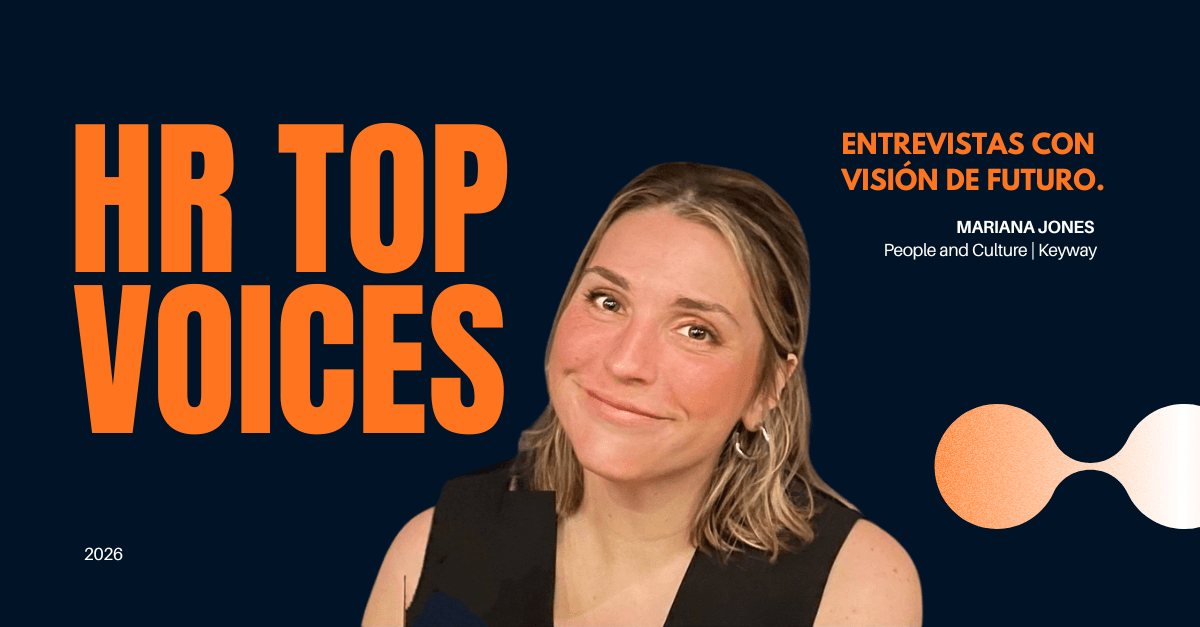
Managing Distributed Teams in 2026 by Mariana Jones
This article is part of HR Voices, Desky's series where we talk with People & Culture leaders about the real challenges of managing remote and distributed teams. No theory. What's actually happening in the day-to-day lives of those living it.
There's a version of remote work that appears in job postings. And then there's the one that lives in the everyday reality of the people actually managing it.
The first talks about flexibility, autonomy, and borderless talent. The second talks about benefits nobody uses, managers without support, and climate surveys where nothing ever happens afterward.
Mariana (Nani) Jones worked at Dow Chemical, MuleSoft, Medallia, and Nubank before joining Keyway, where she built the People & Culture department from scratch. She's spent over 15 years managing teams across Argentina and the United States simultaneously, designing benefits and compensation for two markets with completely different logics, and leading technical recruitment processes for teams in LATAM, Europe, and the United States.
She has a perspective you don't learn in any course. We asked her what she'd learned. Here's what she told us.
The most common mistake companies make with remote benefits
Offering something isn't enough. It has to be genuinely accessible.
The numbers back this up: 31% of workers left their job in the past year due to lack of flexibility in their benefits, according to Randstad's Workmonitor 2025. And yet, 70% of global companies still don't have a unified solution for managing benefits across all their countries, according to the Global State of Benefits Report 2025.
Nani learned this more than once: "More than once I've implemented a benefit that looked great on paper and in practice almost nobody used it. And each time I learned the same lesson: it's not enough for something to be available, it has to be genuinely accessible."
The problem is almost never the benefit itself. Sometimes it's communication. Sometimes it just doesn't connect with people's real lives. And sometimes it was designed from behind a desk, without asking anyone.
"Today before I launch anything, I ask. It seems obvious but it's harder than it looks."
In small teams, that's relatively easy. In larger organizations, it requires staying close enough to avoid assuming you already know what people need. And in teams distributed across multiple countries, you also need to understand that what provides security in Buenos Aires isn't the same as what works in New York.
A benefit that creates bureaucracy isn't a benefit. It's extra work dressed up as a gift.
Want to give your team access to work spaces without HR having to manage everything? With Desky, everyone books where they want and you just check the dashboard. 👉 Explore our enterprise plan
Why "remote work" no longer sets you apart
Nearly every job posting today includes flexibility. The problem is that flexibility can mean very different things depending on the company.
The saturation is real: 85% of professionals say remote work is the number one factor when evaluating a job, according to Index.dev 2025. When everyone offers the same thing, the benefit stops being a differentiator.
"A company can have flexible hours and at the same time have a culture where nobody ever truly disconnects and micromanagement runs deep," Nani points out.
What really sets you apart isn't the policy. It's what people feel when they work there: whether they can be honest, whether their work has meaning, whether someone sees them as a person and not just a resource.
That's the real battleground for attracting and retaining talent in 2026. Not the name of the benefit. What's behind it.
85% of candidates prioritize flexibility. Desky helps you offer it for real: professional spaces in any city, with no local contracts or fixed costs. 👉 Get started today, no platform fees
The most undervalued asset on any remote team: first-line managers
If you had to pick one focus for this year, what would it be?
Nani's answer was direct: "First-line managers. They have the most impact on employee experience and at the same time are the most overlooked when it comes to development and support."
People can't be in every conversation happening within a team. But a good manager can be, or at least in most of them. If managers are doing well, everything else flows much more smoothly.
In remote teams this multiplies. Without an office where conversations happen naturally, the manager is often the only real point of contact a person has with the company. According to AWI data, employees in hybrid models who feel genuine support from their manager are significantly more likely to stay and grow with the organization.
If that relationship is weak, everything else—benefits, culture, communication—arrives muffled or doesn't arrive at all.
Investing in managers isn't a wellness expense. It's infrastructure.
The trap of measuring without closing the loop
There's one practice Nani points out as consuming a lot of energy without moving the needle: climate surveys where nobody does anything with the results.
"You measure, you share the results, and then... nothing. Or worse, a generic action plan that doesn't change anything real. That wears people out more than not measuring at all, because they feel like they spoke and nothing happened."
If you're going to measure, you have to be willing to do something with what you find. If not, better not to ask.
In distributed teams this is especially sensitive. The distance already creates enough disconnection without adding the feeling that opinions don't matter.
What's coming and almost nobody is preparing for
There are two skills Nani sees underestimated today that in no time will be hard filters in any hiring process.
The first: working asynchronously and in writing. Clear thinking, good documentation, decisions that stay recorded. "Today it's barely evaluated and soon it's going to be a huge filter, especially for remote or distributed teams."
The second: organizational change management. With AI transforming how work gets done, the winner won't be whoever implements the most tools. It'll be whoever gets people to actually change their habits without burning out. The data supports this: 64% of leaders expect two-thirds of routine HR tasks to be automated by 2026, according to the Global Workforce Report by Remote.
And when it comes to hiring, Nani has already shifted her focus: "I'm no longer so focused on years of experience but on the ability to learn, to structure problems, to write clearly, and to use AI with judgment."
Fewer vendors, more impact
There's one idea that runs through the entire conversation with Nani and applies directly to how remote teams are managed today: less complexity, more impact.
"My north star for 2026 is simple: less noise, more impact. Smaller teams but stronger ones. I want my focus to be on every person having clarity about their purpose and what they move with their work."
51% of HR leaders are actively looking to replace their current HRIS with an integrated solution that unifies everything in one place, according to Remote's Global Workforce Report 2025. The reason is always the same: too many systems doing one thing.
That logic also applies to managing work spaces. Having multiple vendors to manage coworking spaces in different cities isn't flexibility. It's complexity disguised as a solution.
Companies that best manage distributed teams don't have more options. They have fewer friction points.
One contract. One dashboard. One place from which HR can see who used what, when, and how much. No juggling between vendors. No fixed costs for unused services. No manual management by country.
That's exactly what Desky solves for teams like the ones Nani knows from the inside.
Your team works from more than one city and you're still managing spaces with multiple vendors? Desky gives you access to thousands of spaces across Latin America and Europe from a single contract, with no fixed costs. 👉 Learn how it works for enterprises
Frequently asked questions about strategic HR in remote teams
How do startups with teams in Argentina and the US manage benefits at the same time?
The key is understanding that markets have different logics. What creates security or motivation in Buenos Aires isn't the same as in New York. Before defining any benefit, it's worth asking each team segment what they need. On the operational side, centralizing on platforms that work for both markets eliminates the need to manage local vendors separately.
What are startup HR leaders evaluating in 2026 when hiring for remote teams?
Less and less on-paper seniority, and more and more on the ability to learn, structure problems, and work asynchronously. The ability to write clearly, document decisions, and use AI with judgment already weighs more than years of experience in many hiring processes.
Why do benefits for remote teams end up unused?
Because available isn't the same as accessible. A benefit that requires bureaucracy, complex approvals, or doesn't connect with the real life of whoever receives it ends up unused even though it's in the contract. Before launching anything, it's worth asking people what they actually need.
What should HR focus on this year in distributed teams?
On first-line managers. They're the most direct point of contact between the company and the team, and they're usually the most neglected in terms of development. If managers are doing well, employee experience improves structurally.
How do you simplify managing work spaces for a team across multiple countries?
Centralize with a single vendor with access to multiple cities. That eliminates the need to negotiate local contracts, unifies billing, and gives you real visibility into consumption. You only pay for what your team actually uses.
Desky does exactly that: one contract, thousands of spaces across LATAM and Europe, and full visibility of spending from a single dashboard. 👉 Let's talk if your team is in more than one city
About Mariana Jones
Mariana Jones has over 15 years of experience in People & Culture, Talent Acquisition, and HR Strategy. She worked at Dow Chemical, MuleSoft, Medallia, and Nubank before joining Keyway, where she built the People & Culture department from the ground up and now leads it as Senior People and Culture Manager. She managed benefits and compensation across Argentina and the United States simultaneously, led technical recruitment processes for teams in LATAM, Europe, and the United States, and has spent years thinking about how to keep people thriving in fast-changing environments.
HR Voices
HR Voices is Desky's series where we talk with People & Culture leaders to understand how they're navigating the real challenges of managing remote and distributed teams today.
No theory. No generic trends. What's actually happening in the day-to-day lives of those living it.
If you manage a remote team and want workspace to stop being an operational headache, learn how Desky works for enterprises.
Published by the Desky team — March 2026