Rafael Lellis: "People is not a support area, it's infrastructure"
Rafael Lellis, People at Clara and former Superside, reveals how he identified the root cause of 50 resignations, how he convinced a C-level executive with eNPS data, and why remote teams need to stop relying on meetings.
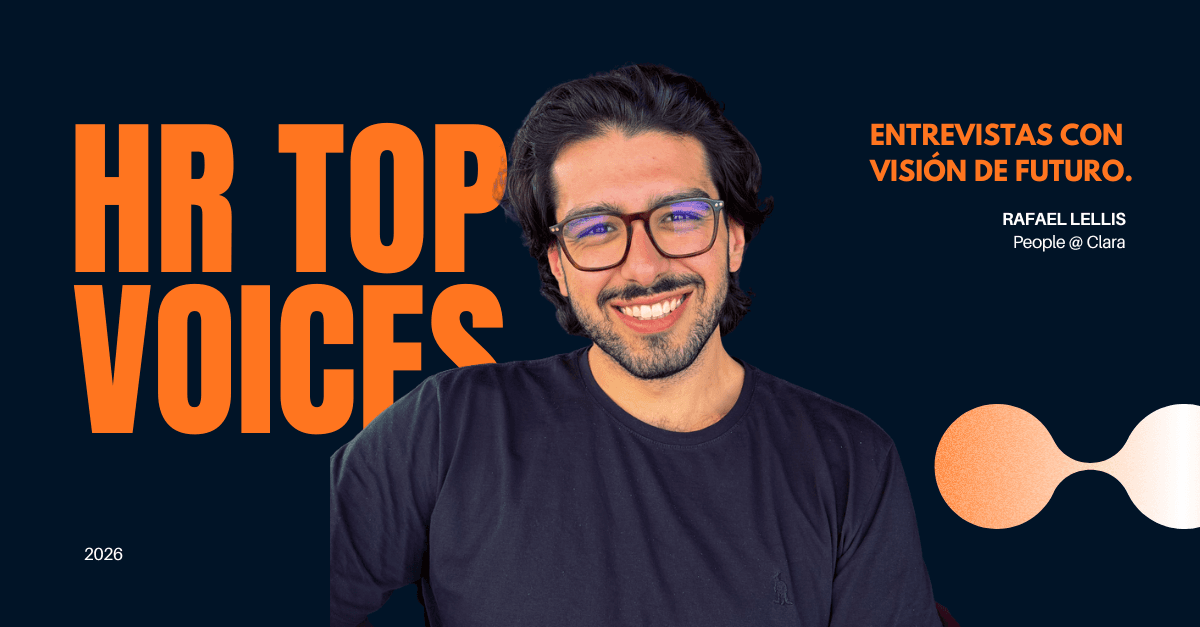
Rafael Lellis: "People is not a support area, it's infrastructure"
HR TOP VOICES
HR Top Voices is Desky's interview series with Workplace, People Operations and HR leaders who are rethinking how distributed teams are managed. In this edition, we speak with Rafael Lellis, People leader at Clara, about culture that becomes operational, data that changes leadership decisions, and what needs to be unlearned to manage 100% remote teams.
From psychologist to People Analytics and organizational design thought leader. A conversation about 50 resignations that nobody knew how to read in time, why a promotion is a structure decision, and how AI can take HR out of work that doesn't require human judgment.
There are HR professionals who look at numbers and others who look at people. Rafael trained for the latter and built his career around the former. And in that intersection, he found his method.
A psychologist by training, he has spent more than ten years in Human Resources across startups, fintechs, consulting, and global tech companies. At Superside, he supported more than 300 people across 70+ countries in a 100% remote setup, working with global leaders on structure, performance, engagement, and People process automation. He worked at hypergrowth companies building performance, compensation, and structure systems from scratch. And in the middle of all that, already a senior HRBP, he found time for an MBA at USP/Esalq.
Today he is at Clara, one of Latin America's largest fintech scale-ups, with an ambitious mandate: combining People, technology, and AI to support the company's next growth stage in Brazil.
His thesis is simple and quite uncomfortable for those who still see HR as a service area: People is part of the infrastructure that allows a company to execute its strategy.
This is the conversation.
50 resignations and a culture that was never operationalized
You posted a real case: 50 resignations in a year, same department, an estimated cost of R$1 million. How was it to uncover the root cause by analyzing each of the 50 exit interviews one by one?
What triggered the alarm wasn't just the volume, but the concentration. When turnover accumulates in a single team, says Rafael, you have to stop treating turnover as an isolated indicator and start investigating the system behind it.
Individual analysis of the interviews showed a very consistent pattern: the perception that certain leadership decisions were not aligned with the values the company said it defended. But the strongest finding was temporal. People had given feedback several times before leaving and, over time, stopped seeing concrete actions as a result. Frustration accumulated until it became a loss of trust.
"People didn't leave because a problem occurred. They left after pointing it out repeatedly and not perceiving changes."
Rafael Lellis – People | Clara
The diagnosis wasn't that people disagreed with the culture, but a lack of coherence between culture, leadership, and the management mechanisms that should sustain it. The response was structural: review performance evaluation criteria, redesign the organizational chart, and implement change management practices so values would stop being a statement and appear in how the organization decided, evaluated, and changed.
"Culture only becomes real when it's operationalized."
Rafael Lellis – People | Clara
When data changes a C-level's mind
You created three sharp translations: turnover → real cost, eNPS → correlation with performance, onboarding → ramp-up time. In which one did you see a C-level change their opinion?
In the intersection of eNPS, engagement, and performance. There was a leader who was very defended because, despite having very low eNPS and engagement indicators, he reached his objectives. The underlying argument was that as long as there were results, the team's experience could wait.
Rafael took the discussion out of the perception arena. He crossed engagement and eNPS from different teams with their performance indicators and a clear relationship appeared: teams with better eNPS also showed better results. And that leader's team wasn't even among the best performers. The conversation stopped being about whether the leader was "good" or "bad" and became about what type of leadership is associated with sustainable performance. There was a leadership change and afterward, a significant improvement in the team's results.
"When a company decides to keep a leader who delivers results but systematically generates a bad experience for their team, it's communicating to the entire organization what leadership behaviors are acceptable."
Rafael Lellis – People | Clara
For him, the conclusion is direct: engagement is not a "soft" metric. Connected to business results, it becomes a decision variable for leadership and performance.
Remote-first: the rule that had to be thrown away
At Superside you led People for more than 300 people across 70+ countries, 100% remote. What organizational design rule that works in an office-based company did you have to discard?
The idea that meetings are the main alignment mechanism. In an office, much of communication happens through proximity: the hallway, the quick question, the impromptu meeting. With teams spread across dozens of time zones, that model doesn't scale. Making everything synchronous meant multiplying meetings or, worse, forcing some people to always work outside their natural hours.
The solution was to treat communication as part of organizational design: internal communications and change management designed to work asynchronously, supported by project management tools, documentation, and document commenting, with a combination of very clear autonomy and accountability.
"In remote settings, you can't rely on proximity to generate alignment. You need to create systems that make context, decisions, responsible parties, and next steps visible."
Rafael Lellis – People | Clara
His definition sums up the learning well: remote-first doesn't mean working from home, it means redesigning how the organization communicates, decides, and generates accountability.
An editorial note is worth adding: that same logic of designing systems instead of relying on proximity also applies to spaces. When the team is in dozens of cities, giving each person a place to work well usually ends up in a different contract per city and a different bill per provider. It's the problem that platforms like Desky solve by centralizing access to coworkings in Latin America and Europe in a single contract, paying only for usage.
Does your team work from more than one city? Desky gives you access to thousands of coworking spaces in Latin America and Europe from a single contract, with no fixed costs or country-by-country negotiations. 👉 Learn about Desky's enterprise plan
Organizational design: more than drawing boxes
You went through hypergrowth companies building performance, compensation, and structure from scratch. What redesign makes you most proud today, in hindsight?
The one at a post-Series A startup whose structure, ideal for the first stage, was starting to create bottlenecks. One of the founders still concentrated much of Sales, Marketing, and customer relationship decisions. It made sense when the company was small; it no longer did to scale.
The People work was to move from a founder-led structure to a scalable one: separate fronts, incorporate a Head of Sales, give more autonomy to Customer Relations leadership, and hire a CMO, with clear ownership for each area. Additionally, activities and responsibilities were mapped to detect overlaps, gaps, and efficiency opportunities.
"Organizational design is not drawing boxes on an org chart. It's designing the capacity the company needs to execute its strategy."
Rafael Lellis – People | Clara
You wrote publicly that promotions depend on much more than performance: visibility, budget, calibration, real business need. Tell us more.
Clarity came to him in calibration committees, where he learned to separate two questions that usually get mixed: whether the person is ready for the next level, and whether the organization needs someone at that level.
His example: a Legal area with three Legal Counsels reporting to a Head. One of them had the performance and maturity to be a Legal Manager, but creating that position meant adding an intermediate layer between three people and their boss. More hierarchy, more bureaucracy, less speed. In such cases, the best answer can be a compensation review: recognize the evolution without creating a structure the business doesn't need.
"A promotion happens when there is a combination of consistent performance, readiness for the next level, and a real business need."
Rafael Lellis – People | Clara
And he adds a responsibility for HR: helping managers and employees understand that career advancement doesn't have to happen only through title changes.
The psychologist who became analytical
You're trained as a psychologist, but built your career on the harder, more numerical side of HR. How do those two perspectives combine when you make decisions?
He doesn't see them as opposites. In fact, he believes Psychology is what brought him to the analytical side. It taught him to look at the behavior behind indicators—motivation, perception of fairness, group dynamics—but it also showed him that a good hypothesis about behavior is still just that, a hypothesis.
"Psychology helps me understand the behavior behind the data; data helps me check whether my interpretation of that behavior is correct."
Rafael Lellis – People | Clara
That combination helps him avoid two extremes: deciding only with numbers, forgetting that you work with complex social systems, or deciding only with perceptions and good intentions, without measuring impact on the business.
You did your MBA at USP/Esalq while already a senior HRBP, in the middle of your career. What led you to formalize theory just at that moment?
His career was built by learning through practice, with responsibilities taken on early. At one point he saw the limit of that path: he had a lot of empirical knowledge and wanted a theoretical and executive repertoire to understand the models behind his decisions. The MBA let him name and contextualize problems he had already faced—strategy, incentives, finance, organizational design—and question solutions he had repeated just because they had worked before.
"Experience taught me to deal with reality and ambiguity; theory gave me models to interpret that reality in a more structured way."
Rafael Lellis – People | Clara
AI in People: automating what doesn't need human judgment
At Superside you automated People processes with AI. What was the first process you managed to get out of the team's hands?
Managing onboarding information. The flow was manual and full of handoffs: Talent Acquisition had new hire data, shared it in a Slack channel, People Ops loaded it into the HRIS, and then HRBPs validated it. Each handoff was an opportunity for incomplete or inconsistent data.
Using n8n and Zapier, they directly integrated the ATS with the HRIS and added a Slack bot that made automatic checks, asked for missing information, and flagged anything outside the standard. The criterion was key: automate only the stages that didn't need human judgment and leave the team in charge of exceptions.
"The goal is not to replace human work; it's to eliminate the operational work that prevents the team from acting more strategically."
Rafael Lellis – People | Clara
Today you're at Clara. What attracted you to joining right now, and what mandate do you feel you were given?
The combination of scale and ability to build. Clara is already a reference among fintechs in the region and, even being a unicorn, maintains the profile of a builder company, with a team that develops highly personalized internal tools with AI. That poses a particular People challenge: having the right people with autonomy and execution capacity, while multiplying their potential with technology.
The mandate, as he describes it, goes in that direction: not just having the best possible team, but leveraging all its potential, using AI to capture and amplify the experience and knowledge that already exist in the organization. Behind it is a larger ambition: that Brazil becomes Clara's main market in the medium term, and a regional reference for how to build and scale a fintech.
People as infrastructure
You wrote that "People is not a support area, it's infrastructure." If you had to prove it to a skeptical founder with just one example, which would you choose?
I'd go back to the post-Series A startup that went from depending on a founder to having distributed ownership. Not for the org chart itself, but for what it resolved: if the strategy was to grow and the structure depended on one or two people to decide, there was a contradiction between strategy and execution capacity.
"We weren't solving a Human Resources problem. We were eliminating a constraint on the business's ability to execute."
Rafael Lellis – People | Clara
And he makes a clarification that dismantles the most common misunderstanding: saying People is infrastructure doesn't mean HR should get involved in all decisions. It's the opposite. Its role is to build the organizational conditions so the business can decide without depending on People for everything.
Frequently asked questions about People, organizational design, and remote teams
Why can a declared cultural value end up generating turnover?
Because when the value doesn't reflect in leaders' decisions, in performance criteria, and in accountability mechanisms, people perceive an incoherence. If they also give feedback and don't see changes, frustration accumulates and ends in resignations, like in the case of 50 departures Rafael analyzed.
How do you demonstrate that engagement impacts business results?
By crossing eNPS and engagement data by team with their performance indicators. When the correlation appears, engagement stops being a "soft" metric and becomes a variable for deciding on leadership.
What changes in organizational design for a 100% remote company?
Alignment stops depending on meetings and proximity. Communication, change management, and project management are designed to work asynchronously, with documentation, visible context, and clear responsible parties, regardless of time zone.
How do you access work spaces for a team distributed across several countries without adding providers?
By centralizing on a platform that gives access to coworkings in multiple cities with a single contract and billing for actual usage. Desky offers that model in Latin America and Europe, with no fixed costs.
Is your team growing in several cities or countries and work spaces becoming another provider to manage? Centralize access to coworkings in a single contract and one invoice, paying only for what your team uses. 👉 Explore how Desky works for companies
This article was prepared based on an interview for the HR Top Voices series, in collaboration with the Desky team, a flexible workspace platform for remote teams in Latin America and Europe.