The Eye No Academy Teaches: Melanie Quaglia on Leading People
Melanie Quaglia worked at Despegar, Ualá, Naranja X and today leads teams at Mendel. A psychologist by training with specialization from MIT, she shares what hypergrowth, layoffs, and data taught her about truly managing teams.
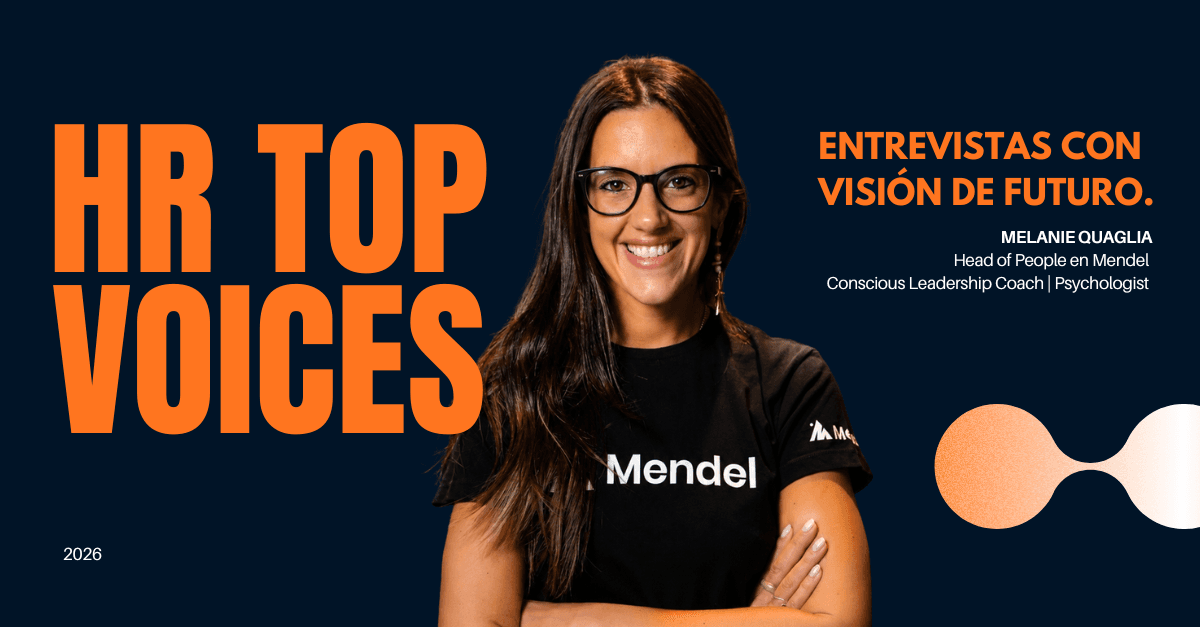
The Eye That No Academy Teaches: Melanie Quaglia on Leading People Through Chaos
Despegar → Ualá → Naranja X → Mendel. Psychologist by training, HR Master's from UCEMA, and MIT specialization in Design and Innovation. Nominated for the Globant Awards Women that Build.
There are HR careers built by reading through processes. And there are careers built in the fire: office openings with zero experience, hypergrowth fintech, layoffs you have to sustain without breaking.
Melanie Quaglia had both.
A psychologist by training with an HR Master's from UCEMA and a Design and Innovation specialization from MIT, she's worked at Despegar, Ualá, Naranja X, and today leads the people function at Mendel—the scaleup that went from "we'll never be more than 100" to over 150 people in three years and counting. For over a decade, she's been bringing clinical thinking and analytics together without seeing them as competitors, and she believes in positive psychology and learnability as today's key tools.
We asked her to look back—not to recount a polished career, but to name the moments that really shaped her, the ones that matter to anyone leading people in a context moving faster than anyone can process.
Ualá: When People Stopped Being Support
Despegar was her first school: post-IPO scale, massive hiring, an HR team of 80 people at a company with 18 years of history behind it. There she learned to operate big, but from the ground up, in an already mature structure where her role was mostly to absorb.
The real breakthrough came at Ualá, when the fintech was just three or four years old and the HRBP role didn't even exist yet. They had to build it from scratch, and that absence became the key.
"Because there was nothing in place, we became real partners to the tech, data, and product teams. We weren't supporting them from the outside—we were at their inner circle, inside structural decisions, processes, and projects."
That's when she stopped thinking of People as a support function. Her stakeholders moved the core business metrics, and there was no way to hide behind a process: what she did showed up directly in operations.
It's a distinction that helps any People leader who today feels their team is "outside" the important decisions: the inner circle isn't requested—it's built by showing up when nothing is yet in place.
Culture Doesn't Sustain Itself
Ualá also left her with a useful scar: how to sustain culture when a company grows faster than its processes.
She doesn't romanticize it. It was a culture of high demand and pressure, and sustaining it was complex—something she acknowledges outright, though she also understands why it happens so often in fintech, where everything moves at lightning speed. From that she drew a distinction she applies differently today:
"It's great to decide fast, but sometimes it's worth taking five minutes longer before you say 'A' and have to rush out saying 'B'. That back-and-forth is what wears people down the most."
It's not about thinking more, she clarifies. Many times you have to decide with half the information, or none at all, and that's unavoidable in those contexts. It's about taking the risk a bit more deliberately before cascading the decision.
And what made constant pressure bearable wasn't the demand itself—it was the team. Feeling there was a safety net, that nobody was carrying the weight alone. Today she doesn't take for granted that pressure "comes with the job": she treats it as something that has to be actively sustained, managing the pace of decisions and the team pushing them through.
What Shapes You Isn't a Degree
We asked her about her Globant Awards nomination. Her answer went straight somewhere else: the layoff processes she led.
"In a layoff you're supporting everyone at once and from different angles. Your own team, who often has half the information but still has to operate. The people getting the bad news. The other leaders, who'll have to let their people go and need support to do it right. And the company's leadership, at maximum exposure."
The hardest part, she says, comes after the worst is over and you have to go out and motivate the team again, to keep going; the leaders, who are shaken. Rebuilding culture from a fragile place, without denying what happened.
From that experience she takes a definition of leadership that doesn't depend on any org chart:
"We all lead, directly or indirectly. It's not a title or a team to manage. You lead every time others need your clarity to move forward."
It's probably the most portable idea from the whole conversation: it works just as well for someone managing fifteen people as for someone who doesn't manage anyone but still holds a team together through a difficult moment.
The "Eye" That No Academy Teaches
With an HR Master's from UCEMA and an MIT specialization on her resume, Melanie is clear about what academics gave her: a methodology, a way of thinking through problems, a framework so you don't start from scratch every time you need to solve something.
What no curriculum teaches is something else.
"Human situations are as specific as there are people. There's a kind of intuition you need to figure out what a person or team needs in a specific moment, in a specific context. That's not in any program. It has something of creativity, even inspiration: reading what's happening and knowing what to move."
She calls it the "eye": the tension between the process and the actual team. A process can make perfect sense at the organizational level, even be creative, and still feel canned or useless when applied to a specific team. The eye is knowing when a process works as-is and when it needs customizing.
And it gets sharper when the company grows fast, because the temptation is always to standardize everything to scale. "Academia teaches you to design the process; what it doesn't teach you is when to break it. Only the field gives you that judgment."
Giving Clarity Without Having All the Answers
At Mendel, the EOS methodology sets objectives quarter by quarter. That means the hiring plan changes constantly, to the point that the CEO himself told her during the interview that they'd never be more than 100 people. Today they're over 150 and still growing. The level of dynamism says it all.
Melanie admits that more than once she told her team "these are the last openings we need to fill," convinced at the time, only to have to open new ones anyway.
"What I learned is to be honest about what we know and what we don't, and still give the team a framework to move forward: 'let's work these openings as priority today, knowing the plan might shift next quarter'."
For her, clarity in a startup isn't having all the answers. What matters is that the team knows where they stand, even when the ground moves and priorities shift. "We got used to this and achieved enough momentum that today it lets us move fast without frustration when the plan changes, because we understood that's how Mendel grows—and we do too!"
For any leader who today communicates plans they know will change, the distinction matters: the problem isn't not having the answer. The problem is not warning that you don't have it yet.
What Only the Newcomer Sees
Her time at Naranja X left her another lesson, this one about what's lost with seniority. There everyone talks naturally about the "magic" of their culture, taking it so for granted they barely mention it anymore. It's part of what you breathe in the air.
"The outsider picks up really fast what creates that magic. What best practices, what soft things they do for each team's specific needs, what makes it work. And that's huge learning, because you're seeing it with the curiosity of someone still asking questions about everything."
Then there's the learning about the business itself—understanding the product, the differentiator in user experience, why people choose it over something else. It's, she says, one of the most fun things about joining a company that's been in the game for years.
What's nice, and urgent, is that this fresh perspective doesn't last long. After a few months you start taking things for granted too. So you have to make the most of the window while it's open—it's maybe the simplest and most overlooked advice for anyone starting in a new role.
Psychologist in a World of OKRs
Trained as a clinical psychologist and working today with OKRs and people analytics, Melanie doesn't experience this as tension. Quite the opposite: over the years, her view on data has completely shifted.
"Today I'm convinced that even the softest topics can be translated into metrics, because 'data beats narrative' and there's nothing better than empirics to get heard, to secure buy-in, to mobilize action. Quantifying what's happening is what earns you a seat at the table."
But data, she says, tells you what's happening—not always why. A team dropping in engagement, someone starting to feel uncomfortable: the dashboard shows the signal, not the cause.
"Listening, being close, reading what someone isn't saying with words: that's what lets you understand the real cause, which often isn't what the dashboard suggests."
She doesn't experience it as tension between clinical and analytical, but as a complement: "Clinical training gives me the human reading, the depth, the relationship; and data gives me the way to show it, to make it visible and actionable for the organization. One without the other falls short."
Betting on Someone Without the Title Yet
At 22, as just an analyst, Melanie led the opening of Despegar's IT office in Córdoba. A responsibility that normally doesn't go to that level.
"I had almost no experience, I was an analyst, and I had to lead opening an entire office. Today I remember some things they asked me to do and I think 'how did I have the guts?'. But that's exactly where the first learning is: that we don't have limits, and a junior's naiveté, when channeled right, can take you really far. Sometimes not knowing everything that could go wrong is what gives you the courage to jump in."
From that project she takes two learnings she holds to today. The first: in the corporate world, you grow by showing what you do—some self-promotion with judgment and humility is fine and necessary, because nobody's going to put a value on your work if you don't do it first. The second, the one that marked her most: building a real team with your stakeholders. The project was co-led between People and Tech, and the tech leaders were never "the internal client"—they were true allies. "Partnering with your stakeholder isn't a detail, it's what makes a project succeed or not."
That experience deeply changed how she bets on others. At Mendel they intentionally hire people without experience, fresh grads—"we believe in the hunger of someone with everything new and everything to learn: the energy, the passion, the drive to take on the world". She was that person given an enormous opportunity without the title for the role, and she says she knows firsthand the unmatched potential of someone young when you trust them. "Someone took that leap for me, and today I'm happy taking it for others."
The Uncomfortable Truth About HR
We asked her, after all this time, what's the problem the sector won't say out loud. She answered straight, in three layers.
First: the will to care for people is there, but today's environments are super demanding, and achieving balance between what the business asks and real care for people is incredibly hard. Often wellbeing is talked about on the surface while the underlying demands never drop.
Second, connected to the first: People still doesn't have, in many places, a real seat at business decisions. And that includes her, because it's something that happens everywhere in the sector—the habit of executing without daring to challenge, of receiving the decision already made instead of being at the table where it's defined.
Third, more practical but equally important: the role still has way too much operational work. So much that it leaves no air to stop, think, and automate.
"I think HR has huge potential when it comes to AI and we're still way behind. And obviously, I'm not talking about replacing the human element: there's something in the relationship, the listening, that won't ever be replaced, and that's fine. But if we freed ourselves from so much operational work, we'd have exactly the time to be at that table, to challenge, to care better. It all connects."
At bottom, she says, the problem is staying so trapped in the urgent and operational that you don't occupy the strategic place that would actually let you care for people, and not just as a talking point.
What You Take From This Conversation
If we had to sum up in a handful of ideas what Melanie built over fifteen years moving between Despegar, Ualá, Naranja X, and Mendel, it would be this:
- The inner circle isn't requested, it's built by showing up when nothing is yet in place.
- Deciding fast isn't the same as deciding well. Five more minutes of definition save way more wear and tear later.
- Pressure doesn't come free with the job. You have to sustain it actively, and the team is what makes it bearable.
- Leadership doesn't depend on a title. It depends on others needing your clarity to move forward.
- There's an "eye" that only the field gives you: knowing when a process works as-is and when you need to break it.
- Clarity isn't having all the answers. It's the team knowing where they stand, even when the plan changes.
- Data shows the signal; listening explains the cause. Neither is enough alone.
- Betting on someone without the title yet is, often, the best bet you can make.
"What makes you a leader isn't recognition or a job title. It's being there when things get complicated, when definitions are missing, and when you execute beyond the circumstances because others depend on you to move forward."
Melanie Quaglia
HR Top Voices is Desky's series where we give the mic to those leading people at the fastest-growing companies in Latin America. We don't want LinkedIn speeches or abstract trends: we want people who already burned through hypergrowth, sustained a layoff, or had to invent a role that didn't yet exist at their company. Melanie is exactly that—someone who learned leadership by doing it, not by reading about it.
About Melanie Quaglia: Psychologist by training, passionate about people. HR Master's degree (UCEMA), agile methodologies, and a Design and Innovation specialization from MIT. Over 10 years working in Human Resources, passionate about supporting high-performance teams. She believes in positive psychology and learnability as today's most powerful tool. She's obsessed with improving people's experience and aligning each person's purpose with the organization's: creating business value while making people happier. Tech enthusiast and unconventional thinker. Vegetarian for 14 years, traveler, amateur photographer, and devoted Boca Juniors fan.
Managing a distributed team and still dealing with multiple workspace providers? There's a simpler way. 👉 See how Desky works for enterprises
Published by the Desky team — July 2026