The Future of Workplace Manager is Breaking Down the Silo
From Booking.com to Abacum, through COVID at Typeform and the war in Ukraine at Preply. An HR Top Voices interview with Natascha Oliveira Lisboa on leading Workplace & People Operations without a manual.
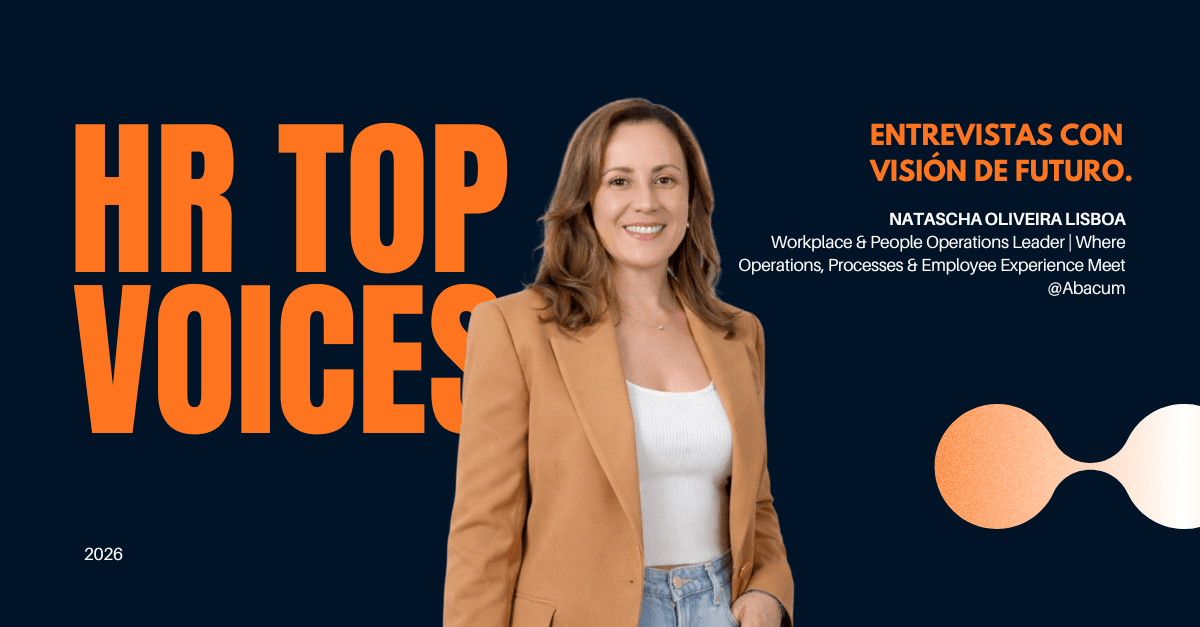
Natascha Oliveira Lisboa: "The Future of the Workplace Manager is in Stopping Being a Silo"
HR TOP VOICES
HR Top Voices is Desky's interview series with Workplace, People Operations and HR leaders who are rethinking how distributed teams are managed. In this edition, we spoke with Natascha Oliveira Lisboa, Workplace & People Operations Leader at Abacum, about growing without breaking employee experience, leading without a manual and where her profession is heading.
From Executive Secretary in Brazil to leading Workplace & People Operations across three continents. A conversation about growing without breaking employee experience, leading without a manual and why physical space stopped being just square meters.
There are careers that are explained with an org chart and there are careers that are explained with crises. Natascha Oliveira Lisboa's belongs to the second group.
She started as an Executive Secretary in Brazil, made a lateral jump to sales at a pharmaceutical company — where she discovered that proactivity isn't taught, it's trained — and landed in Workplace almost by accumulation of responsibilities. At Booking.com she witnessed the transition from 2 to 700 employees in four years, operating Barcelona, Madrid and Bilbao simultaneously. She arrived at Typeform five months before the world shut down for COVID and had to invent, without a manual, how to sustain a distributed team in panic. At Preply she coordinated support for 40 employees and their families affected by the war in Ukraine in 48 hours. At Cognativ she cut 30% of office operating costs and, along the way, was promoted from Workplace and Culture Manager to Senior Manager of Workplace and HR.
Today, from Barcelona, she manages Abacum's offices in Barcelona, New York and Toronto. And she has a clear thesis about where her profession is heading: Workplace shouldn't be a separate department from HR. It should be its closest extension to the ground.
This is the conversation.
From Booking.com to Abacum: scaling without breaking employee experience
What's the first thing that breaks in a company when it grows so fast, and how did you see it coming?
For Natascha, the answer lies in the connection between people, processes and culture. If onboarding, communication and employee support don't evolve at the same pace as the business, the experience starts to deteriorate before anyone notices it in a climate survey. In the first six months of the hyper-growth stage at Booking, they were bringing in thirty people every two weeks.
"At Booking I learned that you can't wait for the problem to appear to react. You have to get ahead of it, understand what the organization is going to need and build scalable solutions."
Natascha Oliveira Lisboa – Workplace & People Operations Leader | Abacum
How many offices do you manage today at Abacum, and is it a similar scale to Booking?
Three: Barcelona, where she's physically located, New York and Toronto. But it's a different challenge, she clarifies. Booking was pure hyper-growth — going from a minimal group to 700 people in years. Abacum is growing significantly from 2025, though with a different nature. What remains is the bridge role: between Workplace, HR and Employee Experience.
At Typeform you managed 300 people in Barcelona and 30 in San Francisco at the same time. Are you experiencing something similar today — one headquarters short on space while another has excess?
Yes, and she describes it as something common in any international organization. Barcelona concentrates more population; New York and Toronto are smaller offices. But there's a line she doesn't cross: she doesn't believe Employee Experience means offering exactly the same thing to everyone, but ensuring that everyone has a coherent, thoughtful experience aligned with the company's culture, regardless of where they work. The balance, she says, is between global consistency and local adaptation.
Leading without a manual: COVID, Ukraine and decisions that don't wait
You arrived at Typeform five months before COVID. What decision from those first two weeks of March 2020 makes you proud today, looking back?
Understanding quickly that the priority wasn't to maintain normalcy, but to give people security in the face of something completely unknown. She coordinated with management the transition to remote — chairs, screens, whatever each person needed — but insists that operations were secondary. What mattered was being available and maintaining close communication when nobody knew how long it would last.
"We didn't have a manual for that. We had to learn and adapt decisions practically day by day."
Natascha Oliveira Lisboa – Workplace & People Operations Leader | Abacum
Five years later, how was presence resolved at Abacum?
Hybrid model, with some positions 100% remote. But Natascha makes a distinction that often gets lost in the generic "remote vs. office" debate: the debate shouldn't simply be remote vs. office. The more interesting question from the People side is what the organization needs and what people need to work well, collaborate and feel connected to the company. Workplace, she says, has to evolve based on that answer, not the other way around.
At Preply you coordinated support for 40 employees and their families affected by the war in Ukraine, with no prior protocol. What specific decision did you make in the first 48 hours?
Moving the Contingency Team from HR to another floor of the building. It sounds operational, but it had a specific purpose: creating a space where quick and confidential decisions could be made, and protecting the rest of the team from the tension those conversations inevitably generated.
"Leading in moments of uncertainty doesn't mean having all the answers. It means knowing how to prioritize, making decisions with the information available, anticipating the impact they can have on people and adapting the plan as the situation evolves."
Natascha Oliveira Lisboa – Workplace & People Operations Leader | Abacum
Budget, vendors and the myth of the one-size-fits-all coworking
At Cognativ you achieved 30% reduction in operating costs. How did you measure it — intuition or a concrete number?
Neither a major decision nor a stroke of luck: the sum of procurement, renegotiation with vendors and targeted adjustments — changing the electricity provider, for example, generated relevant annual savings. But the definition she's left with from that stage is more conceptual than financial: saving doesn't simply mean spending less, it means understanding where the value is and how to better use the resources available.
You mention that negotiating with coworkings city by city "eats you alive". At Abacum have you already centralized with a single vendor?
No, and she explains why that's not always a mistake: each city has different needs, and centralizing at any cost can mean losing flexibility. What she does value about the coworking model in general is having a partner that takes care of reception, maintenance, services, security and facilities — freeing up your Workplace team's time for employee experience and higher-value projects. The key, she insists, is choosing the right model for each company's moment; there's no one-size-fits-all formula.
This is a point worth an editorial clarification: the fragmentation that Natascha describes — a different contract per city, a different invoice per vendor — is exactly the problem that platforms like Desky started solving in Latin America and Europe, centralizing access to coworking spaces in a single contract and a single invoice, without losing the flexibility to choose city by city.
Does your team work from more than one city? Desky gives you access to thousands of coworking spaces in Latin America and Europe from a single contract, with no fixed costs and no negotiations country by country. 👉 Discover Desky's enterprise plan
Where is the Workplace Manager heading?
At Cognativ you went from Workplace and Culture Manager to Senior Manager of Workplace and HR in a matter of months. What does that evolution tell you about the role in general?
That Workplace and People shouldn't function as silos.
"The person who is close to employees every day has a very valuable vision of what's happening in the organization. They listen, observe and detect needs that may not appear in an engagement survey or in a formal HR process."
Natascha Oliveira Lisboa – Workplace & People Operations Leader | Abacum
That's why, she says, the future of the role involves a broader vision: not just managing spaces and vendors, but contributing directly to employee experience, wellbeing, engagement and culture.
If you had to bet: in three years, does the Workplace Manager exist as we know it, or does it dissolve into People/HR? Which scenario would you rather be on?
Her bet is clear: the role continues to exist, but evolves toward a function much more connected with People and HR. She'd like to see Workplace professionals with active participation in wellbeing, engagement and employee experience, with the strategic value they ultimately bring finally recognized. And personally, she has no doubts about which side she wants to be on:
"I want to keep evolving toward People and HR because I feel it's a natural evolution of my professional experience."
Natascha Oliveira Lisboa – Workplace & People Operations Leader | Abacum
Her bet is to contribute right from that intersection — understanding the business, caring for people's experience, and turning that into processes, spaces and solutions that work for both.
Frequently asked questions about the Workplace Manager role
Is the Workplace Manager role going to disappear into HR?
According to the experience of leaders like Natascha Oliveira Lisboa, the role doesn't disappear, but transforms: it shifts from managing only spaces and vendors to having an active function in employee experience, wellbeing and engagement, increasingly integrated with HR.
Is it worth centralizing coworking vendors on a single platform?
It depends on the company's stage. Centralizing reduces operational and negotiation burden, but can reduce flexibility if each city's needs are very different. Platforms like Desky seek to resolve that tension: a single contract with access to spaces in multiple countries, without losing the ability to choose city by city.
How do you manage employee experience in hybrid teams distributed across several countries?
The key is not to offer the same thing to everyone, but to guarantee a coherent experience aligned with the company's culture, adapted to the reality of each office.
How other companies solve it
The case of Candor Investment Group — 100% remote team, distributed across several countries, that centralized access to coworkings through Desky without negotiating contracts country by country — is not isolated. Each company solves the same space problem in its own way, based on how its team is structured:
- Darwin IA: workspaces in Mexico and Brazil without negotiating with each local vendor — everything is resolved in a single monthly invoice, instead of separate contracts per country.
- CookUnity: solves the space for its in-person week in Peru, once a month, without paying for a fixed office that would sit idle the rest of the time. It's, in miniature, the same logic that explains that 40% of idle space regionally: you pay for a fixed office if you need it every day, not if you need it one week. Neither of these cases buys a fixed asset. They buy control over a variable resource, with full visibility and cost tied to actual use — the difference between managing blind and having a dashboard that tells you what you have, where it is and how much it costs you.
Do you manage a distributed team across multiple offices and still deal with multiple coworking vendors? There's a simpler way to centralize spaces without losing local flexibility. 👉 Explore how Desky works for companies
This article was developed based on an interview for the HR Top Voices series, in collaboration with the Desky team, a flexible workspace platform for remote teams in Latin America and Europe.
Haven't measured your office's actual utilization yet? Start here: How to measure your office's real utilization rate →