Vanina Armesto: "There are things you can't fake or program"
Vanina Armesto, Chief People Officer at Escala 24x7, discusses how she sustains a unified culture across more than 15 countries and why human touch remains irreplaceable. Vanina Armesto, CPO at Escala 24x7: culture, talent and the AI era.
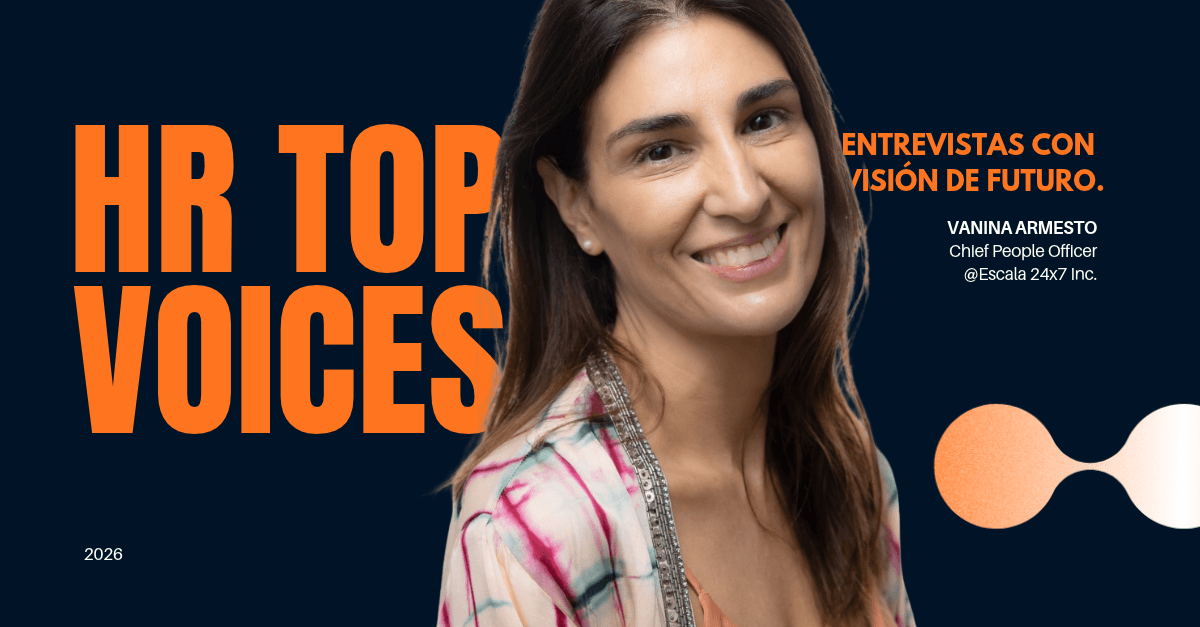
Vanina Armesto: "There are things that cannot be faked or programmed"
HR TOP VOICES
Three takeaways from this interview
1. "When HR speaks the language of business, the boardroom opens up a space for you because they trust you."
2. "What goes unsaid can stall a team's talent."
3. "The best value proposition is the one that makes someone reject an outside offer."
HR Top Voices is Desky's interview series with the People leaders who are redefining how teams are built, managed, and cared for in Latin America. In this edition, we spoke with Vanina Armesto, Chief People Officer at Escala 24x7, about the place of humanity in the age of AI, how HR earns a seat at strategic decisions, and what it takes for the same culture to feel the same across more than 15 countries.
In 30 seconds
- Who she is: Vanina Armesto, psychologist (UBA) and Chief People Officer at Escala 24x7, with over 20 years in Human Resources.
- AI and people: Technology helps you think better, but it doesn't replace listening, supporting, or embracing a team.
- HR at the table: A seat at strategic decisions is earned by understanding the business 100% and showing the value people generate.
- Retention: In a market with nearly 30% attrition, combining talent attraction and employee experience was key to retaining talent.
- Multi-country culture: The 3HS values (Humble, Hungry, Honest & Smart) sustain the same culture across more than 15 countries.
Vanina Armesto jokes that she couldn't live without Claude or Gemini. She's Chief People Officer at Escala 24x7, a company that runs on the cloud and AI, operates in more than 15 countries, and is an AWS premier partner. She works, quite literally, surrounded by algorithms.
And yet, when asked what's most valuable to a team, she doesn't talk about software. She talks about a hug.
There's no contradiction. There's a way of understanding work that few people in HR manage to articulate so clearly: technology is the engine, but people are still the ones driving.
Vanina is a psychologist from the University of Buenos Aires and has spent over 20 years in Human Resources. She was part of Santander's digital transformation when the bank decided to reinvent itself, simultaneously led talent acquisition and employee experience at Naranja X in one of the region's most aggressive talent markets, and today is the architect of Escala's culture.
One trait emerges repeatedly in the conversation: whenever asked about an accomplishment, she passes the credit to others. To leaders, to teams, to those who mentored her. It's the leadership style of someone who prefers to conduct the orchestra rather than play the solo. And it's also the best definition of what a People function does when it works well.
This is the conversation.
AI and the human factor in Human Resources: what no technology can do
In a business that runs on cloud and AI, you've publicly defended the idea that "there's no technology that replaces a hug, warmth, and the emotion of a team." Why did that message resonate so much?
Vanina doesn't speak from the trenches of someone who fears technology. She speaks from within. She loves AI, relies on it every day, and has a precise idea of how to use it: not as an oracle that gives answers, but as a flashlight that helps you see better. The key, she says, is asking it good questions so it helps you think, dig deeper, and explore further.
She even admits something many feel and few say: she's still surprised by how empathetic AI can seem when it knows each person's communication style.
But seeming isn't being. And that's where she draws the line:
"People still need another person who listens to them, supports them, celebrates them, challenges them, and pushes them to find that talent and inner fire."
Vanina Armesto – Chief People Officer | Escala 24x7
That authenticity, she says, doesn't come from a generated response:
"There are things that cannot be faked or programmed, and that's where we continue to make a difference as human beings."
Vanina Armesto – Chief People Officer | Escala 24x7
For an HR function that today feels the pressure to automate everything, the message works as a compass. The question isn't what AI can do, but what it should never do. Delegate the payroll, yes. Delegate the moment when someone needs to be heard, no. At Escala, the work of People is to ensure that human side is always present, with the conviction that each person impacts what the customer ultimately receives.
How HR earns a place in strategic business decisions
What advice would you give to the next generation of HR leaders in Latin America to earn a place in strategic business decisions?
For years, HR claimed a place at the table. Vanina flips the question: it's not about asking for the chair, but about bringing something no one else at that table can bring.
For her, that place is earned by being part of the business, understanding it 100%, and showing the value people generate. And not with speeches, but by answering questions any CEO wants to hear: how much more impact could the company generate if it worked differently, what's the talent density in the organization, how does it learn better and better each day, and how does it stay a leader in the industry without falling behind.
These questions aren't answered with an absenteeism dashboard. They require HR to stop speaking its own dialect and learn the language spoken at the table.
"When HR speaks the language of business, the boardroom opens up a space for you because they trust you."
Vanina Armesto – Chief People Officer | Escala 24x7
The keyword is trust. It's not negotiated or demanded: it's built, question by question, decision by decision.
Before closing, Vanina leaves a personal note that's worth as much as the advice: getting here was never an end in itself. What brought her was following her passion, taking risks even when scared, and making the effort, which was considerable. Always with the idea of leaving a mark at each station along the way, understanding how her work impacts people's lives.
Why HR needs to become less operational: working with what goes unsaid
You have over 20 years in HR and you're a psychologist from UBA. What did that perspective give you that differentiated you from other leaders with more operational profiles?
Every team has a visible part and a submerged part, like an iceberg. The visible is processes, objectives, meetings. The submerged is relationships, pending conversations, and above all, what goes unsaid. And it's that part, the part you can't see, that usually sinks ships.
Vanina explains it without metaphors: what goes unsaid can lead to conflicts and act as a blocker to unleashing a team's talent or bringing out its best version. Psychology gave her a lens to detect what's not visible or on the table, surface it, and work through it until it's unblocked.
This leads to an idea that should make more than one HR function uncomfortable: the operational is precisely the easiest thing to automate. If HR's value is in loading data, approving requests, and moving paperwork, that value has an expiration date. That's why, she says, the role should become increasingly less operational. The real contribution is understanding the business HR is embedded in and how people impact it.
"It may sound clichéd, but I can't find another way to say it: talent is what makes the difference in a project, with a client, in the employer brand, and against the competition."
Vanina Armesto – Chief People Officer | Escala 24x7
It does sound clichéd. But coming from someone who spent two decades looking beneath the surface, it carries different weight.
Retaining talent with nearly 30% attrition: the lesson from Naranja X
At Naranja X you simultaneously led talent attraction and employee experience. What advantage is there to thinking about both ends together?
To understand the answer, you need to go back to the context. The digital talent market was a race with no finish line: every company was racing against the clock for the same profiles, each offering a better proposal than the last. Everyone was chasing the stars, Vanina remembers, "and the non-stars too." Average market attrition hovered around 30%.
In that scenario, many companies operated like a leaky bucket: they kept investing more and more to attract talent from above while losing it from below. Having a single view of both ends allowed them to plug the hole. They built an employer brand that functioned both as a magnet and an anchor: attracting those outside and keeping those inside secure.
"A good value proposition isn't just one that convinces someone to accept an offer, but also one that leads them to reject an external one when it comes."
Vanina Armesto – Chief People Officer | Escala 24x7
It's a higher bar than it sounds. Most value propositions are designed for the first yes. Very few are designed for the second no, the one someone says when a headhunter calls them on a Tuesday afternoon.
The condition to achieve it, according to Vanina, is the same one running through the entire interview: working as part of the business, understanding the organization's purpose, and connecting with those who make it up.
Organizational culture across more than 15 countries: how to feel like a "climber" anywhere
You're the architect of culture for a company operating in more than 15 countries at the same time. How do you make Escala's essence feel equally authentic in each one?
Sustaining a culture in a single country is already hard. Doing it in more than 15 is like keeping the same song playing on fifteen different radios, each with its own equalizer. The risk isn't that the song changes suddenly, but that it slowly goes out of tune.
At Escala, the tuning fork has a name. Everything starts with a conviction from the founder: people are the engine of the business. That idea became a mantra and today every leader is responsible for sustaining it. To do that, the company works with cultural and leadership principles based on its founding values, the 3HS: Humble, Hungry, Honest & Smart. The intention is for them to be present at every moment in the employee journey and in every connection space.
Added to that are standards of excellence in the delivery of products and services, also transmitted as part of the DNA. And that's where the most demanding test of whether the culture works appears—one that isn't measured in internal surveys but outside: a client working with teams from different countries receives the same Escala quality. That's part of what sustains it as an AWS premier partner.
"Each country has its own character, and that enriches us, but it's those values and standards that unite us and make being a 'climber' feel the same anywhere."
Vanina Armesto – Chief People Officer | Escala 24x7
Same language, different accents. That seems to be the formula.
An editorial note is worth mentioning: when culture is built in every connection space, those spaces also need to exist physically. At companies operating in many countries, bringing a team together in Lima, Bogotá, or Mexico City usually means a different supplier per city, a different contract, and a different invoice. Platforms like Desky solve that part with access to coworkings and meeting rooms across Latin America and Europe through a single contract, paying only for what you use.
Does your team work from several countries? Desky gives you access to thousands of workspaces and meeting rooms in Latin America and Europe through a single contract, with no fixed costs or country-by-country negotiations. 👉 Discover Desky's enterprise plan
From Santander to Escala 24x7: three lessons for leading in technology
You went from a traditional bank at Santander to leading people at a 100% cloud company today. What learning from that transition made you a better leader?
Some moves happen with boxes, others happen in your head. Vanina's was the latter kind.
She arrived at Santander at a very particular moment: the bank had decided to transform and digitize at high speed, and she had the opportunity to work alongside industry technology leaders. She describes it as a professional rebirth. To become the leader she is today, she first had to empty her backpack: unlearning the most "corporate" mandates she brought and making room for a different mindset.
From those years she brought three lessons any HR function can put into practice tomorrow. First, iterate and measure every action to correct quickly when needed, instead of waiting until year-end to discover something didn't work. Second, drive everyone's leadership, making all feel responsible and part of it regardless of role or hierarchy. And third, question the status quo that doesn't generate value for the business or, especially, for the end user.
"I feel like I'm the result of that experience and the ones that came after, where I had the chance to surround myself with people with great leadership who left their mark on my career."
Vanina Armesto – Chief People Officer | Escala 24x7
Again, credit directed outward. As if each stage of her career were another layer of the same work built by many hands.
Diversity: don't start with the goal
In one year, the diversity of talent in Perú's operations grew exponentially. How do you build a result like that, and what would you tell another HR leader who wants to replicate it?
True to her style, Vanina steps out of the spotlight. The result, she says, isn't from People but from leaders who, through their work, presence, and leadership, spread the culture and invite others to join. They're the first to understand that diversity is part of the company's DNA and that talent is simply talent, no matter where it's from or what label it has.
People, in this story, isn't the protagonist but the bridge. It works in synergy with those leaders to find people who match the company's purpose and their desire to do things differently. "And that's where the magic happens," she sums up.
Her advice, however, goes well beyond diversity. It applies to any cultural transformation a company wants to undertake:
"Don't start with the goal, as if it were just another metric to move, but by transforming your internal perspective and understanding why and for what it's worth going down that path."
Vanina Armesto – Chief People Officer | Escala 24x7
It's the difference between painting the facade and changing the foundation. A number can move in a quarter. A perspective can't. But when the perspective changes, the number follows. And without leaders as protagonists, she finishes, it's impossible.
What HR can take from this conversation
Use AI as a flashlight, not an oracle. Automate the operational and protect moments that need another human being on the other side.
Earn the table with business questions. Impact, talent density, and continuous learning are the language that opens the door to strategic decisions.
Look beneath the surface. What goes unsaid in a team usually costs more than what's said.
Design the value proposition for the second no. Retention starts the day someone rejects an outside offer, not the day they accept yours.
Same language, different accents. A multi-country culture is sustained by clear values, shared standards, and leaders who embody them.
Start with perspective, not with the goal. Metrics move when thinking changes, not the other way around.
Frequently asked questions about AI, strategic HR, and multi-country teams
What role does AI play in Human Resources?
AI helps you think better, explore deeper, and automate the operational, but it doesn't replace the listening, support, and accompaniment people need from other people. That's why HR's value is increasingly in the strategic and human.
How can HR earn a place in strategic business decisions?
According to Vanina Armesto, Chief People Officer at Escala 24x7, by understanding the business 100% and showing the value people generate: how much more impact could be created by working differently, what talent density the organization has, and how it learns better each day.
How do you retain talent in a market with high turnover?
By integrating talent attraction and employee experience. A solid value proposition not only helps someone accept an offer, it also makes them reject an external one.
How do you maintain the same organizational culture in a company operating in many countries?
With clear values that translate into leadership principles and are present throughout the employee journey, and with shared quality standards. At Escala 24x7, the 3HS values and excellence standards ensure a client receives the same quality no matter which country the team works from.
How do you facilitate in-person meetings for teams working from several countries?
By centralizing access to workspaces and meeting rooms through one provider. Desky offers that model in Latin America and Europe, with billing for actual use and no fixed costs.
Does your team grow across multiple countries and workspaces have become another provider to manage? Centralize access to coworkings and meeting rooms in a single contract and one invoice, paying only for what your team uses. 👉 Explore how Desky works for companies
More HR Top Voices
- Rafael Lellis (Clara): "People isn't a support area, it's infrastructure"
- Federico Manó (Mentify): "Purpose is the flotation device that keeps you afloat"
This piece was developed from an interview for the HR Top Voices series, in collaboration with the Desky team, a flexible workspace platform for distributed teams in Latin America and Europe.